"Better is the end of a thing than the beginning thereof." --King Solomon
We have not yet finished all our AO/HEO readings for the year. Here is a list of what we are reading or have read in the last three months. Most of these books will be finished by mid-July or earlier.
The journey is vital and perhaps more important, but finishing is valuable too.
Cornflower (AO Year 5)
Story of the World Vol. 4 by Susan Wise Bauer
Book of Marvels by Richard Halliburton (finished yesterday)
Age of Fable (this will go for another year)
Poetry of Paul Dunbar and John Greenleaf Whittier
Usborne Complete Book of the Human Body (not my first choice, but I couldn't find our copy of Christian Liberty Nature Reader 5, and this is what we had at hand)
This Country of Ours (almost finished after three years!)
Inventing the Future (biography of Thomas Edison-- finished)
Passion for the Impossible (biography of Lilias Trotter)
The Sciences by Edward Holden (almost finished)
Kim by Rudyard Kipling
Battlefield of the Mind for Kids by Joyce Meyers
Mariel (HEO Year 8)
English Literature for Boys and Girls
The Case for Christ (finished)
The New World (2nd volume of Churchill's History of the English Speaking Peoples)
Essays of Sir Francis Bacon
Christopher Columbus, Mariner (finished)
A Coffin for King Charles
Secrets of the Universe (Fleisher)
The History of Art by Jansen (almost finished-- we are going to read Van Loon's art history book next year as a group)
Kon Tiki (finished)
Poetry of Milton
How to Read a Book (Adler/Van Doren)
Ourselves by Charlotte Mason
Aravis (HEO Year 11)
The Hiding Place (finished)
Is God a Moral Monster? (finished)
A Short History of Western Civilization
Testament of Youth (finished)
The Men Behind Hitler (finished)
Economics in One Lesson (finished)
On Writing Well
Six Easy Pieces
The Microbe Hunters (finished)
Amusing Ourselves to Death (finished)
The Chosen (finished)
Fahrenheit 451 (finished)
The Hungarian Revolt (finished)
Nuremberg: the Justice Trial (finished)
Brideshead Revisited (finished)
Darwin's Black Box
History of Art (Jansen)
When God goes to Starbucks
A History of the American People by Paul Johnson
Ourselves by Charlotte Mason
All of Us Together
Leviticus (finished)
Numbers
1 & 2 Corinthians, Galatians, Ephesians, Philippians, Colossions, 1 & 2 Thessalonians, 1 & 2 Timothy, Titus, Philemon, Hebrews, James 1 & 2 Peter, 1/2/3 John, Jude (finished-- we read these fast because we wanted to read the letters as *whole epistles*-- the way they had been read originally)
Revelation
Romans (with our church)
The Holy War by John Bunyan
Emma by Jane Austen
Madam How and Lady Why (Mariel and Cornflower and I-- almost finished after two years!)
Showing posts sorted by date for query madam how and lady why. Sort by relevance Show all posts
Showing posts sorted by date for query madam how and lady why. Sort by relevance Show all posts
Saturday, June 02, 2012

Monday, April 30, 2012
A Principle of Science
In science we must be cautious and modest, and ready to alter our minds whenever we learn fresh facts; only keeping sure of one thing, that the truth, when we find it out, will be far more wonderful than any notions of ours.
--Charles Kingsley, Madam How and Lady Why
--Charles Kingsley, Madam How and Lady Why
Tuesday, February 14, 2012
Look and Think
"I want you to look and think. I want every one to look and think. Half the misery in the world comes first from not looking, and then from not thinking. And I do not want you to be miserable.
"But shall I be miserable if I do not find out such little things as this?
"You will be miserable if you do not learn to understand little things: because then you will not be able to understand great things when you meet them. Children who are not trained to use their eyes and their common sense grow up the more miserable the cleverer they are."
--Charles Kingsley, "Field and Wild", from Madam How and Lady Why
Schoolwork (Term 2, Years 5, 8, 11)
This is for me-- an exercise in perspective. Every so often I get frustrated. My house never really gets clean and I wonder why. The kids and I have a hard time finishing our AO readings and I wonder why. I always feel rushed and I wonder why. When I detail our schoolwork, I realize how much I am either overseeing or directly guiding, and reasons become evident! I wonder. It is so much, but time is short. The girls are growing older.
Update: A FB friend helped me see that I need a bit more explanation on this post. This is just a list of what we are doing right now for school. I wrote it to help myself see the school choices we make in our household. These choices necessarily kick out other options, such as thoroughly cleaning the house, visiting friends or having ample down time. If we want those options, we have to kick out some of these other things. Sometimes I think I can do everything. But I can't. I bet you can't either. ;o) This is my list. Make your own list and look at what-all you are doing...
Group Work
- We finished Ephesians today and are beginning Philippians. We are pulling out ideas on serving God because he loves us and we love him.
- Proverbs: We have been making wisdom/foolishness lists, but changed things up this week. Now the kids are giving short joint narrations on select proverbs. I'm combining ideas from theater improv, impromptu speech, and progym maxim. I call it "maxim improv" and treat it like a game.
- Emma by Jane Austen. After we are done with Emma, I want us to read a Scott novel-- perhaps Kenilworth.
- The Holy War by John Bunyan
- LittleLa decided she was tired of sitting on the sidelines, so she has joined us in Lost Tools of Writing I. I started her on Lesson 1. She has just completed her first ANI. The other two girls are finishing Lesson 6. I am debating whether to stay on Lesson 6 for awhile, or to get through Lesson 7 before stopping down and honing skills. Lesson 7 is the *Complete* Persuasive Essay. We are beginning to get overwhelmed by the work, though. I want the kids to internalize processes before we add more.
- We try to go to the YMCA for yoga twice per week. (My personal goal is once per week.)
- We belong to a small group that meets for fine arts every couple weeks. The kids are currently learning about the Russian Nationalist composers and the art of Van Gogh, as well as taking classes in sol-fa and applied art, and reading Shakespeare's As You Like It and the poetry of Alfred Noyes.
- We are almost through "Field and Wild" in Madam How and Lady Why by Charles Kingsley. It is a great chapter. If you are struggling to get through the book, hang on. "Field and Wild" is worth it. In a little while, I'll post a quote about thinking v. guessing. After we get finished with MHLW, I want to start The Sea Around Us. None of us has ever read it through, although we have tried. I just got a young person's version of the book from pbswap. It looks like the same text, but lots of pictures, diagrams and maps. Yay!
- I just started KISS Grammar with the two younger kids after years of Winston Grammar. Although the kids know their parts of speech from nouns through prepositional phrases, we started at the beginning of KISS. I like his in-depth explanations of verbs.
- Together we are reading This Country of Ours by H.E. Marshall, the portion about the 19th Century. We are comparing La's other history reading to the history found in TCOO.
- We just began Kim. For now, we are focusing on setting and characters. The plot hasn't yet thickened. ;o) Okay, I guess the plot of Kim is thick from the start! But it is hard to understand the book if you don't have some framework of culture, geography, etc.
- We also share the reading of The Sciences by Edward Holden. We read what he wrote, summarize it, and then go on How Stuff Works or another website to get the updated version. Sometimes we do the experiments. My success rate with the experiments is low, but at least she is getting a good introduction to all the sciences. We are currently in the physics section.
- Her independent readings include Abraham Lincoln's World by Genevieve Foster, Book of Marvels by Richard Halliburton, The Usborne Complete Book of the Human Body, Bulfinch's Age of Fable, Passion for the Impossible (biography of Lilias Trotter) and the poetry of Henry Wadsworth Longfellow.
- We do dictation and copywork twice each per week, and I give spelling words once per week based on words she misspells in her narrations. I am not satisfied with our dictation efforts. I think something needs to change, but I don't know what. La is also working through a notetaking book and a free online Spanish program.
- Four days per week we do 45 minutes of MEP Math. Sometimes she has additional work to finish on her own.
- She also takes violin and piano lessons and plays in an orchestra.
- Together we read Ourselves by Charlotte Mason and How to Read a Book by Adler/Van Doren. We have discussion and she applies what she learns to her life/reading.
- Her independent readings include Christopher Columbus, Mariner by Samuel Eliot Morrison, English Literature for Boys and Girls by H.E. Marshall, Fearfully and Wonderfully Made by Dr. Paul Brand, Galileo's Daughter by Dava Sobel, I Promessi Sposi, Secrets of the Universe by Paul Fleisher, The Case for Christ Lee Strobel, The New World by Winston Churchill, Jansen's History of Art, and the poetry of Robert Burns. Mariel is studying the Renaissance and Reformation.
- Four days per week we work on MEP math for 30 minutes. She usually has some work to finish on her own. The last week or two we set MEP aside and worked exclusively on math problems in her physical science book.
- She is working through Apologia Physical Science this year. I have her applying SQ3R as her narration, then she does the On Your Own questions, labs (with friends) and study guide before taking the test.
- She is working through Grammar of Poetry, but that has slowed down the last few weeks.
- She just started the Essays of Francis Bacon. In each essay she gives his thesis and then either refutes or confirms it based on her own reading and experience. I had Aravis outline and rewrite these essays when she did Year 8, but I like this new idea better. Mariel can rewrite Lamb's essays next year.
- Mariel also takes violin lessons and plays in the orchestra. She is taking a break from piano. And she studies Spanish with Javamom.
Aravis' Work (HEO Year 11)
- Aravis and I work together once per week. We are calling her a junior (11th grade) this year. She is studying the 20th Century. During our together time we read Paul Johnson's History of the American People and Ourselves (Book 2: Self-Direction) by Charlotte Mason, and discuss some of her other books as well as time management and future plans.
- Her independent readings include A Short History of Western Civilization by Sullivan, et al, Brideshead Revisited, Economics in One Lesson (Hazlitt), Here is Your War (Ernie Pyle), Six Easy Pieces (Richard Feynman), Testament of Youth, The Chosen, The Men Behind Hitler, The Microbe Hunters, Theodore Roosevelt's Letters to His Children, Endurance: Shackleton's Incredible Voyage, History of Art, Anne Frank: the Diary of a Young Girl, and On Writing Well. She wants to read all of these and is a quick reader, but perhaps she needs more chapters per week of fewer books. A couple of the books are leftovers from an earlier term, but she was excited to begin the new books, so a couple of 'reading slots' are doubled up in this list.
- She is almost done with Is God a Moral Monster? and is about to start When God Goes to Starbucks (both by Paul Copan). The Starbucks book deals with everyday apologetics. The moral monster book discusses questions of God's righteousness in the Old Testament.
- Aravis started the year doing Apologia Physics, but after a few modules we suspended that study until after she finishes trigonometry, which she is taking at the college. She will take up physics again in March and work through the summer to finish.
- She is working through Intermediate Logic by the Nances, but that has recently slowed down. She did Introductory Logic a couple of years ago.
Monday, November 21, 2011
Exam Week: Analysis and Synthesis
Here is another exam narration from Little La. The book is Madam How and Lady Why by Charles Kingsley. La gets a bit cute with her answer on this one, and had a hard time spelling "analysis", but I'm glad she understands the difference between analysis and synthesis and has begun to see the importance of each. I corrected spelling for reading ease (emphasis hers):
Analysis and Synthesis were brothers and the grandchildren of Madam How. Analysis took apart and analyzed. Synthesis put them back together again.
One day, Synthesis captured Analysis because he wanted all the power. He starved Analysis in the dungeon and forced him to tell him how things worked.
Madam How was not pleased. Not ONE bit.
But after months Analysis escaped. He analyzed, but no one could do Synthesis' job. So, analysis and Synthesis made up and were nice.
Madam How LOVED this. Many bits.
Saturday, July 02, 2011
Madam How and Lady Why Notes: Ch. 7
Ch. 7 The Chalk-Carts
*Interesting website on chalk in the UK:
http://www.geologyshop.co.uk/chalk.htm
*P. 138 The “ignoble army of noodles, who think nothing interesting or important but dinners, and balls, and races, and backbiting their neighbors…” Hee hee.
*The Odiham Chalk Pits are in Hampshire, Southeast England, UK
*copse: a small group of trees
*grubbed: removed by digging
*P. 139 “Learn from the thing that lies nearest you.”
*P. 141 Empirical knowledge: “…his knowledge is sound and useful because it comes from long experience.” The farmer’s knowledge came from careful observation.
*Chalk, a type of limestone, “sweetens” soil, or raises its pH, making it less acidic. (eHow)
*A great picture of the chalk grasslands in South England:
http://en.wikipedia.org/wiki/File:Beachy_Head,_Sussex,_UK.jpg
*P. 142 The “silver Itchen” is a chalk stream. Chalk streams have unusual characteristics:
http://en.wikipedia.org/wiki/Chalk_stream
*P. 145 Kingsley compares the chalk stream to the chalk-cart. They both carry chalk, but how differently they do it.
*marl: lime-rich mud (Wikipedia). Here is a photo:
http://en.wikipedia.org/wiki/File:MatmorFormation2009.JPG
*P. 146 A possible transformation: chalk into marl into coral into limestone into marble.
*Whernside is in Yorkshire, Northern England
*A swallow-hole is also known as a sink-hole:
http://en.wikipedia.org/wiki/Sinkhole
*P. 151 Cave formation; stalactites and stalagmites
*The dropping-well at Knaresborough, now known as the Petrifying Well:
http://www.mothershiptonscave.com/the_petrifying_well.htm
*Proteus: cave salamander or olm (http://a-z-animals.com/animals/olm/)
*P. 153 The vanishing lake:
http://en.wikipedia.org/wiki/Lake_Cerknica
*Mammoth Cave in Kentucky:
http://www.nps.gov/maca/index.htm
*P. 153-154 Cave adaptation: partial or total blindness, and, in the case of the ducks, lack of feathers. Interesting to note that the ducks quickly re-adjusted to life in the upper world—growing feathers and regaining their eyesight.
*The cave at Caripe, Venezuela:
http://en.wikipedia.org/wiki/Cueva_del_Gu%C3%A1charo_National_Park
*Guacharos, or Oilbirds:
http://en.wikipedia.org/wiki/Oilbird
*P. 157 “It will not do for us (at least if we mean to be scientific men) to use terms without defining them.”
Madam How and Lady Why Notes: Ch. 6
Ch. 6 The True Fairy-Tale
*Lapland: a region in northern Finland and Sweden. The indigenous people of this area are known today as the Sami.
*P. 121 “…at the mouth of the Lena and other Siberian rivers…” This very detailed PDF gives historical and geographical information on the River Lena. I never heard of this river before I read MHLW, but it is one of Asia’s major waterways, located in the Russian Federation. Its delta system is the largest in the world.
http://profpaulcutter.com/PDF/Historical%20writings/Siberian_River.pdf
*P. 121 Kingsley discusses various land bridges that existed before the Ice Age, as well as now-extinct animals that crossed into the northern hemisphere. The Ice Age idea has always been rather hazy to me, so I like to refer back to Answers in Genesis. This web page also deals with the propagation and extinction of woolly mammoths:
http://www.answersingenesis.org/articles/nab/where-does-ice-age-fit
*P. 122 “…the land was sinking…” This statement and its opposite is asserted several times in the book—the land was rising, the land was sinking. What does Kingsley mean? In the chapter on volcanoes, the land rises because of the addition of volcanic matter. Where earthquakes are concerned, tectonic shifts cause rising and sinking. This is called “uplift” and “subsidence”. In this chapter, could he mean the press of ice sheets on land caused it to sink? When the ice sheets melted, perhaps there was a gradual release of the land. Also, erosion would cause sinking as well as rising because of gravel and sand redistribution. Also, rising sea levels (such as in a global warming or a global flood) would cause an illusion of sinking land. Hmm. There is so much to consider when pondering the causes of geological change. I could not find satisfying links for this question, but here are a couple of somewhat unsatisfying ones.
*A global warming article from 2009:
http://www.telegraph.co.uk/earth/earthnews/6226537/England-is-sinking-while-Scotland-rises-above-sea-levels-according-to-new-study.html
*“…mountains and valleys during the Flood were not the same height as they are today.” -Answers in Genesis (you may wish to refer to Ch. 5 for a reminder about the differing viewpoints of Uniformitarianism and Catastrophism)
http://www.answersingenesis.org/articles/2009/07/06/did-noah-need-oxygen
*P. 122 “And it grew wondrous cold…” poetry from “The Rime of the Ancient Mariner” by Samuel Taylor Coleridge
*P. 124 The arrival of man in England, France and Germany. “Perhaps they came into that icy land for fear of stronger and cleverer people than themselves; for we have no proof, my child, none at all, that they were the first men that trod this earth.”
*P. 125 Kingsley wonders at the difference between the wit of man and the wit of apes. I love that part.
*Interesting archeological find (article published June 2011) at an ongoing dig site indicates very early human occupation of the Caucasus Mountains, which are between Europe and Asia. This mountain range is the location of Mount Ararat.
http://abcnews.go.com/Technology/wireStory?id=13774778
*Kent’s Hole is in Torquay, Devonshire (SW England)
*brecchia: rock composed of fine fragments embedded in sand or clay (Merriam-Webster)
*Cave etchings:
http://www.newscientist.com/article/dn977-ancient-cave-etchings-reveal-unusual-figures.html
*P. 128 “…[prehistoric man] had the same wonderful and mysterious human nature as you…”
*P. 129 Kingsley puts forth his “fairy” theory, that the “little people” were actual people smaller and weaker than the Picts and Scots and Gauls, and were driven underground.
*The story of Corineus and Gogmagog, as told by John Milton:
http://www.sacred-texts.com/neu/eng/prwe/prwe004.htm
*P. 131 Neanderthal Man: The Neanderthal is a valley in Germany between Dusseldorf and Eberfeld. The famous Neanderthal Man, a prehistoric hominid skeleton, was found there. There are several theories regarding Neanderthals, some of which belie Kingsley’s description! Kingsley published MHLW in 1869. Neanderthal Man was discovered in the 1850s:
http://www.answersingenesis.org/docs2003/0217neandertal.asp
*P. 132 “Truth is stranger than fiction.”
*P. 134 “That you might wonder all your life long, God put you into this wondrous world.” In the final pages of the chapter, Kingsley encourages the young reader to marvel at the true stories of nature-- they seem like fairy tales, but are much deeper and stranger than stories devised by man. I am willing to wade through the dated science in this book for passages like this one-- passages that give us a beautiful way of thinking—a philosophy-- of science.
Wednesday, March 02, 2011
What We are Reading
We are fairly discombobulated at this point in the school year, but I wanted to put out a post on the books and other resources we are enjoying right now.
We are currently reading Exodus and the Gospel of Mark together. Individually, we are reading the book of Acts, and coming together to discuss questions sent to us by our pastor. (We had a visiting preacher last Sunday. He preached on seed-time and harvest. We had just read and discussed the parable of the sower, and of the seed that grew up, and of the mustard seed. I love it when the Lord does that.)
We are also reading North with the Spring by Edwin Way Teale. We have gotten to Lake Okeechobee in Florida, so we aren't very far into it yet.
That book took the place of The Merchant of Venice by Mr. William Shakespeare, which we finished a few weeks ago. Aravis is also student-directing a very short version of A Midsummer Night's Dream with our literature co-op, and Cornflower is playing Helena.
In Mariel's literature class, we are reading the United States Constitution and hearing presentations on the lives of the Signers.
We put Madam How and Lady Why and It Couldn't Just Happen on the back burner until the end of March, because Mariel and Cornflower are each taking trips with my parents. (Mariel just got back from hers, yay!)
Cornflower and I are reading Kidnapped and Abigail Adams together. She also asked me to help her with This Country of Ours-- it is pretty dense and she understands it better when we read it aloud. She is reading Age of Fable and George Washington's World on her own. She finished Minn of the Mississippi and Explore His Earth last week, which is good, because I require detailed written narration of each episode in GWW, and that takes some time.
She is also reading the poetry of Emily Dickinson, but it is about time to switch over to William Wordsworth. I have a hard time getting into William Wordsworth, but I won't tell that to Cornflower. Maybe she will like him.
Her free reading right now is The Borrowers and Pollyanna.
Mariel and I have not read together in three weeks, because she has been on vacation with my parents, and what a trip she had! She took some books with her, including Joan of Arc by Mark Twain and her Apologia general science book. Joan got read, science did not. Ha.
We are going to dive in again today. We have Mere Christianity, Ourselves, and The Birth of Britain. We especially like Mere Christianity, because we talk walks while we are reading it. He throws so many amazing ideas out that Mariel wants to stop reading and discuss things every couple of paragraphs, and that really lends itself to walk-reading.
On her own, Mariel is reading A Taste of Chaucer, English Literature for Boys and Girls, How the Heather Looks, Age of Chivalry and Idylls of the King. I just love AO Year 7.
Aravis is reading most things on her own, but we do have a couple of read-togethers: Graves of Academe by Richard Mitchell, How to Read Slowly by James Sire, and the second part of Ourselves by Charlotte Mason. I find Mitchell's semantics difficult to understand sometimes-- I have to keep reminding myself that he was writing in the late 70s/early 80s, and those words may mean something different today. Or maybe it isn't semantics and I just don't get it. But every so often, light dawns. We like his humor.
We just got two new books: The Ultimate Guide to Writing Well by Paula LaRocque and Vision of the Anointed: Self-Congratulation as a Basis for Social Policy by Thomas Sowell. Love the title of that last one. Aravis and I are each reading the writing book individually, but we are going to read the book on social policy together, and I can't wait.
(A bit off-topic: Right now I am working on an article, and Richard Mitchell and Paula LaRocque threaten to be my undoing. Every time I read another chapter in their books, I go back to my poor little article and edit ruthlessly.)
Aravis is reading the following on her own: How Should We Then Live? (we watched the video series last year, as well as reading The God Who is There, so I thought she could handle the book on her own), a collection of essays by G.K. Chesterton, The Imitation of Christ by Thomas a Kempis, the poetry of the Brownings, Paul Johnson's History of the American People, Churchill's Great Democracies and the Simonds History of American Literature. She is also reading The Lion, the Witch and the Wardrobe in Spanish with her Spanish class. She just finished Arguing About Slavery. She is also studying chemistry and geometry.
And speaking of math, I wanted to mention that I switched Mariel and Cornflower to Time4Learning. We have used it for around three months, and I think I like it. There are some negative aspects, but I appreciate that I don't have to be as involved in their math learning and that we can access lessons across grade levels for any little concept gaps the girls may have. I still teach them math quite a bit, but now I have little computer animations teaching the math, too. One more helpful thing.
Sunday, January 09, 2011
Notes on Madam How and Lady Why: Ch. 5 The Ice-Plough
I have several 'favorites' within Charles Kingsley's book, and this chapter is one of them. Until I read it, I incoherently viewed glaciers as nebulous chunks of ice somehow related to mountains.
Just as rain is Madam How's gentle spade, glaciers are her ice-ploughs. Great imagery. :)
(Note: If you need the actual links in the body of the post, will you let me know in the comments? Otherwise, for the rest of the book I will embed links to make the posts tidier. Also, I have added the list of notes to my sidebar so previous chapters are easier to find.)
*Pictures of and information about limestone: http://www.mii.org/Minerals/photolime.html
*Scrapes on rock (also called striations) caused by glacial activity: http://www.geography-site.co.uk/pages/physical/glaciers/images/stria01.jpg
*Rosenlaui Glacier in Switzerland: http://en.wikipedia.org/wiki/File:Rosenlauigletscher_vom_Tal_aus.jpg
*In 1891(?), the Rosenlaui Glacier melted more than it had done in many years and revealed Mr. Kingsley's piece of scraped limestone. (Page 99)
*Please note that it is now illegal to remove stones or other artifacts from many nature areas worldwide, although it was not in Mr. Kingsley's time.
*The rocks in Snowdon (Snowdonia Rocks) and lots of educational resources: http://www.eryri-npa.gov.uk/education/introduction/what-is-it-like/snowdonia-rocks
*Snowdon is in Wales.
*Picture of Franz Josef glacier in New Zealand: http://en.wikipedia.org/wiki/File:Franz_Josef_glacier.JPG
*Arial view of the same glacier: http://en.wikipedia.org/wiki/File:Looking_down_the_Franz_Josef_Glacier_from_above_the_Melchior_Glacier.jpg
*More information than you ever wanted to know about glaciers: http://www.geography-site.co.uk/pages/physical.html#Glaciers
*Uniformitarianism: Mr. Kingsley accepted the Theory of Evolution, and on page 100 he declares his uniformitarian position, "And so I treasure this, as a sign that Madam How's ways do not change nor her laws become broken; that, as that great philosopher Sir Charles Lyell will tell you, when you read his books, Madam How is making and unmaking the surface of the earth now, by exactly the same means as she was making and unmaking ages and ages since..." Uniformitarians believe that 'the present is the key to the past,' or all geological changes in the past occurred as the result of the same natural laws and processes that change the Earth's face today. This is where "millions of years" comes from in the Theory of Evolution. http://en.wikipedia.org/wiki/Uniformitarianism_(science)
*FYI: Young-Earth creation scientists generally take the position of Catastrophism, the idea that Earth's appearance is often altered by sudden, violent, possibly worldwide events (ie., Noah's flood). Some catastrophists do not believe that the present is necessarily the key to the past, but that past catastrophic events may even have changed the geological and climactic 'habits' of the Earth, which would explain why the geologic column is jumbled in some areas. http://blogs.answersingenesis.org/blogs/ken-ham/2006/09/28/worldwide-catastrophism-its-becoming-popular/
*Sir Charles Lyell: the foremost geologist in Kingsley's time. Lyell's book,_Principles of Geology_, popularized the uniformitarian viewpoint.
*Grinding whole mountains into plains (a glacial plain in Iceland): http://en.wikipedia.org/wiki/File:Skei%C3%B0ar%C3%A1rsandur,_Iceland.jpg
*The Crimean Winter (pages 100-102): I think he is talking about a Crimea-like winter IN England. (Crimea is a republic near Ukraine on the Black Sea.) 1837-38 was a very severe winter for the British Isles, with many days of below-zero temperatures. The Thames River froze over.
*A painting of the frozen Thames from the 1600s. This is not the same freeze Kingsley is talking about, but it is the same river:
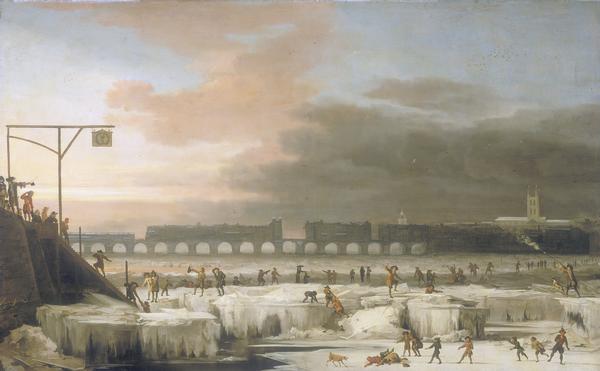
*There was a cool weather period in Europe, known as the Little Ice Age, from the 1300s to the late 1800s/early 1900s. Kingsley doesn't speak of this, but it seems relevant to me: http://en.wikipedia.org/wiki/Little_Ice_Age
*A portion of Perito Merino Glacier falls in Argentina: http://www.youtube.com/watch?v=-wgeG1B3HG8&feature=related
*Sounds aboard an ice-breaker ship: http://www.youtube.com/watch?v=4cMgYRHucoY&feature=related
*_Frost and Fire_, by John Francis Campbell, is available on Google Books: http://books.google.com/books?id=_oosAAAAYAAJ&dq=frost+and+fire+north+america&source=gbs_navlinks_s
*The weight of ice and snow can damage trees: http://www.mobot.org/gardeninghelp/images/Pests/Pest1977.jpg
*Worst snowstorms in U.S. history. Be sure to scroll down and look at the picture of the Knickerbocker Snowstorm, in which a movie theater roof collapsed under the weight of 20 inches of snow: http://thehistorytavern.blogspot.com/2010/12/worst-snowstorms-in-history.html
*Esquimaux in Arctic regions: Yupik, Inuit and Aleutians, also known as Eskimos, traditionally live in Siberia, Alaska, North Canada and Greenland. http://en.wikipedia.org/wiki/Eskimo (scroll for pictures)
*definition of glacier (page 104): "...a river of ice, fed by a lake of snow. The lake from which it springs is the eternal snow-field which stretches for miles and miles along the mountain tops, fed continually by fresh snow-storms falling from the sky. That snow slides off into the valleys hour by hour, and as it rushes down is ground and pounded, and thawed and frozen again into a sticky paste of ice, which flows slowly but surely till it reaches the warm valley at the mountain foot, and there melts bit by bit."
*moraine: http://www.geography-site.co.uk/pages/physical/glaciers/images/climb01.jpg
*glacial river carrying silt (rock flour) into a lake: http://en.wikipedia.org/wiki/File:Muru_memurubu.jpg
*Ullswater: http://commons.wikimedia.org/wiki/File:Ullswater_from_Pooly_Bridge_engraving_by_William_Miller_after_T_Allom.jpg
*Windermere: http://en.wikipedia.org/wiki/Windermere
*A discussion of the Ice Age at Answers in Genesis, which also contains some good pictures and diagrams of ice flow: http://www.answersingenesis.org/articles/nab/where-does-ice-age-fit
Just as rain is Madam How's gentle spade, glaciers are her ice-ploughs. Great imagery. :)
(Note: If you need the actual links in the body of the post, will you let me know in the comments? Otherwise, for the rest of the book I will embed links to make the posts tidier. Also, I have added the list of notes to my sidebar so previous chapters are easier to find.)
*Pictures of and information about limestone: http://www.mii.org/Minerals/photolime.html
*Scrapes on rock (also called striations) caused by glacial activity: http://www.geography-site.co.uk/pages/physical/glaciers/images/stria01.jpg
*Rosenlaui Glacier in Switzerland: http://en.wikipedia.org/wiki/File:Rosenlauigletscher_vom_Tal_aus.jpg
*In 1891(?), the Rosenlaui Glacier melted more than it had done in many years and revealed Mr. Kingsley's piece of scraped limestone. (Page 99)
*Please note that it is now illegal to remove stones or other artifacts from many nature areas worldwide, although it was not in Mr. Kingsley's time.
*The rocks in Snowdon (Snowdonia Rocks) and lots of educational resources: http://www.eryri-npa.gov.uk/education/introduction/what-is-it-like/snowdonia-rocks
*Snowdon is in Wales.
*Picture of Franz Josef glacier in New Zealand: http://en.wikipedia.org/wiki/File:Franz_Josef_glacier.JPG
*Arial view of the same glacier: http://en.wikipedia.org/wiki/File:Looking_down_the_Franz_Josef_Glacier_from_above_the_Melchior_Glacier.jpg
*More information than you ever wanted to know about glaciers: http://www.geography-site.co.uk/pages/physical.html#Glaciers
*Uniformitarianism: Mr. Kingsley accepted the Theory of Evolution, and on page 100 he declares his uniformitarian position, "And so I treasure this, as a sign that Madam How's ways do not change nor her laws become broken; that, as that great philosopher Sir Charles Lyell will tell you, when you read his books, Madam How is making and unmaking the surface of the earth now, by exactly the same means as she was making and unmaking ages and ages since..." Uniformitarians believe that 'the present is the key to the past,' or all geological changes in the past occurred as the result of the same natural laws and processes that change the Earth's face today. This is where "millions of years" comes from in the Theory of Evolution. http://en.wikipedia.org/wiki/Uniformitarianism_(science)
*FYI: Young-Earth creation scientists generally take the position of Catastrophism, the idea that Earth's appearance is often altered by sudden, violent, possibly worldwide events (ie., Noah's flood). Some catastrophists do not believe that the present is necessarily the key to the past, but that past catastrophic events may even have changed the geological and climactic 'habits' of the Earth, which would explain why the geologic column is jumbled in some areas. http://blogs.answersingenesis.org/blogs/ken-ham/2006/09/28/worldwide-catastrophism-its-becoming-popular/
*Sir Charles Lyell: the foremost geologist in Kingsley's time. Lyell's book,_Principles of Geology_, popularized the uniformitarian viewpoint.
*Grinding whole mountains into plains (a glacial plain in Iceland): http://en.wikipedia.org/wiki/File:Skei%C3%B0ar%C3%A1rsandur,_Iceland.jpg
*The Crimean Winter (pages 100-102): I think he is talking about a Crimea-like winter IN England. (Crimea is a republic near Ukraine on the Black Sea.) 1837-38 was a very severe winter for the British Isles, with many days of below-zero temperatures. The Thames River froze over.
*A painting of the frozen Thames from the 1600s. This is not the same freeze Kingsley is talking about, but it is the same river:
*There was a cool weather period in Europe, known as the Little Ice Age, from the 1300s to the late 1800s/early 1900s. Kingsley doesn't speak of this, but it seems relevant to me: http://en.wikipedia.org/wiki/Little_Ice_Age
*A portion of Perito Merino Glacier falls in Argentina: http://www.youtube.com/watch?v=-wgeG1B3HG8&feature=related
*Sounds aboard an ice-breaker ship: http://www.youtube.com/watch?v=4cMgYRHucoY&feature=related
*_Frost and Fire_, by John Francis Campbell, is available on Google Books: http://books.google.com/books?id=_oosAAAAYAAJ&dq=frost+and+fire+north+america&source=gbs_navlinks_s
*The weight of ice and snow can damage trees: http://www.mobot.org/gardeninghelp/images/Pests/Pest1977.jpg
*Worst snowstorms in U.S. history. Be sure to scroll down and look at the picture of the Knickerbocker Snowstorm, in which a movie theater roof collapsed under the weight of 20 inches of snow: http://thehistorytavern.blogspot.com/2010/12/worst-snowstorms-in-history.html
*Esquimaux in Arctic regions: Yupik, Inuit and Aleutians, also known as Eskimos, traditionally live in Siberia, Alaska, North Canada and Greenland. http://en.wikipedia.org/wiki/Eskimo (scroll for pictures)
*definition of glacier (page 104): "...a river of ice, fed by a lake of snow. The lake from which it springs is the eternal snow-field which stretches for miles and miles along the mountain tops, fed continually by fresh snow-storms falling from the sky. That snow slides off into the valleys hour by hour, and as it rushes down is ground and pounded, and thawed and frozen again into a sticky paste of ice, which flows slowly but surely till it reaches the warm valley at the mountain foot, and there melts bit by bit."
*moraine: http://www.geography-site.co.uk/pages/physical/glaciers/images/climb01.jpg
*glacial river carrying silt (rock flour) into a lake: http://en.wikipedia.org/wiki/File:Muru_memurubu.jpg
*Ullswater: http://commons.wikimedia.org/wiki/File:Ullswater_from_Pooly_Bridge_engraving_by_William_Miller_after_T_Allom.jpg
*Windermere: http://en.wikipedia.org/wiki/Windermere
*A discussion of the Ice Age at Answers in Genesis, which also contains some good pictures and diagrams of ice flow: http://www.answersingenesis.org/articles/nab/where-does-ice-age-fit
Saturday, January 01, 2011
Anyone Out There?
Well, I made it almost entirely through Christmas break without helping the kids on their science fair projects or writing the Madam How and Lady Why notes. I spent most of this past week at the DPS, which has in place a remarkable system of avoidance and noninformation for unsuspecting citizens who think they are going to receive civilized treatment.
Nevertheless, as Aravis said in a recent FB status update, we have vanquished the Circumlocution Office and forced it to yield up her drivers license. Rather, she did most of the vanquishing. I really just drove her there and provided moral support and advice and a vehicle for the road test.
So we can cross "get Aravis' license" off the to-do list. But needless to say, waiting in line for hours at the DPS seriously ate into my free time this week. I have several five-finger exercises written for the scales-and-arpeggios book, and I cleaned out our master closet, but that's it. We had a relaxing time over New Year's, mostly recovering from DPS-related shell-shock.
So. We'll see what gets done today and tomorrow. I wanted to at least let folks know that I didn't get to the MHLW notes.
*(The title of this post refers to the fact that I haven't gotten many comments lately. Would you leave a comment if you feel comfortable doing so? I'd like to see how many readers I have. I once had a site counter, but I lost my login info and the site-counter website refused me access when I redesigned my layout and lost the icon, and I haven't had the time nor the inclination to set another one up. So would you leave a comment? Thanks.)
Friday, December 24, 2010
Thinking Out Loud in a Quiet Space of Time
I realized a few days ago, when I sat down to read *all* my friend's FB posts for the first time in weeks, that my life has been moving at a very high speed for the past few months. I haven't read a blog since summer, I guess. I am thankful for this break at Christmas.
I have some projects to work on-- the Madam How and Lady Why lesson notes, and helping the kids with their science fair projects, and figuring out how to meld and adapt to the kids' needs, and I want to design my own set of developmental piano scales and arpeggios on Finale Songwriter.
I wish I had more time to practice myself. I need more time to practice each day, and more time to help my own kids with math and science, and I need time to simmer and continue to develop my own art of homemaking, and I need to sit with my 10yo and hear her thoughts, and walk alongside my 13yo as she makes her way through the middle-school years, and help my biggest girl with requirements for higher education... and listen to her sing... and there is so much driving...
So much. I love this life, and I want to do it ALL. There are limits to time. But God has made me able to do everything required of me. I need to figure out what is REQUIRED and what is an unnecessary add-on.
And all of this busy-ness can mask the wonder:
I wonder as I wander out under the sky
Why Jesus the Savior did come for to die
For poor ornery people like you and like I
I wonder as I wander out under the sky
What a God we have, and He it is that walks with me as I try to figure things out.
Tuesday, December 21, 2010
What I Am Reading
I haven't done a book post in awhile, so here are the books I have read since summer:
Sailing the Wine-Dark Sea, Gifts of the Jews, and Desire of the Everlasting Hills (three books) from the "Hinges of History" series by Thomas Cahill. Cahill is a controversial author because he inserts his opinion and interpretation of history more often than a serious scholar of history (as opposed to a popular writer of history) might. His books tend to get a little too sensational and graphic for me at times, as well. But I try not to view any history book as the definitive work on a subject, because we just do not know for sure what happened, so his interpretations do not bother me much. And he makes me think, which I like. (I will say that I don't just hand these books to my daughters to read, because of the graphic and sensational nature of some sections.)
This fall, I re-read Till We Have Faces by Lewis, feeling like I might have better understanding of the pagan/Greek references after reading Sailing the Wine-Dark Sea. The Lewis book has so many layers to it.
The girls and I just finished Northanger Abbey by Jane Austen, with commentary from Miniatures and Morals by Peter Leithart. We are reading through Genesis some mornings, and only have a couple of chapters left. In the New Testament, we have read Galatians, James and the Gospel of John. We have been using Matthew Henry's commentary for our scripture readings this term, except that we followed our church ministers' email comments and questions for the reading of John. We have Romans next on our list, but I am thinking about reading Colossians first. Our pastor has been preaching from Colossians quite a bit.
I am trying to keep up with Aravis in her school reading, and am currently in the midst of Arguing About Slavery, Paul Johnson's History of the American People, and Churchill's Great Democracies. (I am not keeping up at all in the Churchill book.) I also read excerpts from A Short History of Western Civilization by Sullivan, et al., to further inform our history discussions.
Together, Aravis and I just finished The Law by Frederic Bastiat and are slowly reading through How to Read Slowly by James Sire. (Aravis wrote an essay on Bastiat that I also enjoyed reading, and I may post it to the blog at some point.)
I have also been studying up on chemistry, since Aravis is going through an at-home course on it, and has needed some help. I have read the first several chapters of Dr. Jay Wil's chemistry textbook and a chemistry course blog as well as watching The Teaching Company's high school chemistry lectures (which aren't reading, but make one think just as much). Whew, that is one tough subject, the way it combines natural history and math.
Mariel and I read Ivanhoe by Sir Walter Scott this past term with her literature co-op class, and, in a move that possibly declares my insanity, I allowed her to convince me to read Rob Roy concurrently. (It was fun, but not easy.) We have also begun reading Ourselves, How to Read a Book and Mere Christianity together. We are reading Churchill's Birth of Britain separately and coming together for discussion. I got her through the section on Roman Britain and the Dark Ages, and now she is in the part of the Middle Ages that she is familiar with and is handling the book quite nicely. I am helping her draw out Churchill's points on government. We are also reading The Once and Future King, which she loves. AO/HEO Year 7 is such an amazing year.
Mariel, Cornflower and I are also reading It Couldn't Just Happen and Madam How and Lady Why together during the time that Aravis attends outside classes. Our 'class-time' with these two books has blossomed into discussions on the Earth, the Universe, and our place in it. Love it! (I plan to finish my blognotes on MHLW over Christmas for those of you who are using them. I've discovered additional links for the first four chapters and hope to add those, too.)
As for Cornflower, she and I together are reading Age of Fable and Abigail Adams: Witness to a Revolution, and I am giving her a boost with the geography aspects of Minn. She does well with the story part, but needs help noticing the references to the river and the states and the way cool diagrams in the book. I didn't teach my older girls to pull out references (out of a fear of 'becoming the textbook'), and, as a result, I had to do some remedial teaching on that in middle school. Probably it would be okay either way, but it seems to me a waste to not get as much as possible out of book. I explain to Cornflower that there are many things we can get out of each book, and she is focusing on some things, while I focus on others that are also important and that she can gradually notice on her own, and I try not to get tedious, so I hope I am keeping it CM while also satisfying my own teacher's conscience. It is a balancing act I am sure all CM teachers are familiar with. ;o)
Cornflower and I just finished Robinson Crusoe, too, and have started Kidnapped by Robert Louis Stevenson.
I have set aside almost all of my educational philosophy reading, feeling like it is time to hyperfocus on application for awhile. I am still reading through CM's Volume 6, Toward a Philosophy of Education, with our book club, but that is only once a month.
This list may not be complete, so if I think of other things I have been reading, I will add to it.
Friday, September 03, 2010
Notes on Madam How and Lady Why: Ch. 4 The Transformations of a Grain of Soil
Ch. 4 The Transformations of a Grain of Soil
P. 78 In 1529 in Mexico, the conquistador Cortes ordered one of his men, Montano, to lead a very dangerous expedition to retrieve 60 lbs of sulphur from Popocatépetl (Popo’s Crater), which was used as gunpowder: http://www.dankat.com/mstory/volcano.htm
P. 79-80 The difference between soul/spirit and physical body
P. 81-83 Description of lava flow
Video of Kilauea (Hawaii) erupting: http://www.youtube.com/watch?v=488BkTUsMa4&feature=related
Whinstone: any various hard, dark-colored rocks, esp. basalt and chert (Free Online Dictionary)
Slag: vitreous (glass-like) residue left by the smelting (melting or fusing) of metallic ore (Free Online Dictionary)
Cinder: a burnt or partially burnt substance that cannot be reduced to ashes but is incapable of further combustion (Free Online Dictionary)
Fascinating photo essay of volcanism and other geologic phenomena in Hawaii: http://www.marinebio.net/marinescience/02ocean/hwgeo.htm
P. 85-96 Kingsley explains the rock cycle
Madeira: an island near Portugal
Lothians of Scotland: Lothian is a region in Scotland which includes Edinburgh and Dunbar (Wikipedia)
Rock cycle: http://www.geolsoc.org.uk/rockcycle
Advantages/fertile soil: http://vulcan.wr.usgs.gov/LivingWith/PlusSide/fertile_soils.html
Advantages/mineral resources: http://vulcan.wr.usgs.gov/LivingWith/PlusSide/mineral_resources.html
Advantages/geothermal energy: http://vulcan.wr.usgs.gov/LivingWith/PlusSide/geothermal.html
Potash: a potassium compound often used in agriculture, being an ingredient in fertilizers (Princeton.edu)
Magnesia: also called periclase; magnesium oxide (Princeton.edu)
Silicates: types of rock that consist predominantly of silicon/oxygen; most of the Earth’s mantle and crust are made up of silicate rocks (http://smsc.cnes.fr/lexique/s.htm)
Carbonic acid gas: carbon dioxide gas (absorbed from the air by plants in photosynthesis) (Princeton.edu)
P. 88 Eruption of Skaptar Jokull in 1783 (and some other stories of volcanoes affecting the weather): http://www.volcanoweather.owlinc.org/
West India Islands: West Indies, a group of islands just to the east of South/Central America
Giant’s Causeway/Fingal’s Cave: Two corresponding areas of unique lava formations in Ireland and the Hebrides (near Scotland); they figure in legends about Finn McCool (Fionn Mac Cumhaill) http://en.wikipedia.org/wiki/Fingal's_Cave http://en.wikipedia.org/wiki/Giant's_Causeway
An example of a trap dyke in the Adirondacks of upstate New York: http://www.summitpost.org/route/205900/Trap-Dike-Winter.html
Chalk: http://en.wikipedia.org/wiki/Chalk
An old geological map of the British Isles (volcanic—igneous—rock is labeled ‘E’ for “eruptive rocks” and is colored dark red): http://www.soton.ac.uk/~imw/jpg-Geological-Maps/8GB-Old-Map-British-Isles.jpg
Some very cool pictures of rock formations in the South of England (Wessex), and more geological maps of the British Isles and Europe: http://www.soton.ac.uk/~imw/Geology-Britain.htm
Since we live in Texas, a geological map of our state (igneous rock shown in pink): http://geology.about.com/od/maps/ig/stategeomaps/TXgeomap.htm
Virtual geology field trips: http://www.lib.utexas.edu/geo/onlineguides.html#txandnm
Geological structures and landforms in Dallas County: http://www.geog.unt.edu/~williams/lab_10.htm
Madam How’s ice plough: glaciers
Madam How’s gentle spade: rain
Thursday, September 02, 2010
Notes on Madam How and Lady Why: Ch. 3 Volcanoes
(Previous MHLW posts)
Ch. 3 Volcanoes
My favorite part of this chapter is Kingsley's imaginative description of the eruption of Mount Vesuvius in A.D. 79. :)
P. 123-133 in Exploring His Earth is about volcanoes (and earthquakes)
P. 54-55 is more admonition to people who live near volcanoes and earthquake activity
Relationships between volcanoes and earthquakes: http://volcanoes.usgs.gov/about/faq/faqeq.php
P. 55 Sandwich Islands: an old name for the Hawaiian Islands
P. 55 Pele’s Hair: Thin strands of volcanic glass drawn out from molten lava http://volcanoes.usgs.gov/images/pglossary/PeleHair.php
Story of Kapiolani defying the volcano: http://digital.library.upenn.edu/women/yonge/deeds/deeds.html#volcano
Friendly Islands: an old name for the Kingdom of Tonga
Fortunate Islands: legendary islands believed by the Greeks to be the gateway to Paradise
P. 56 Use the following map (showing earth’s plates and earthquake/volcano activity) and an atlas to locate regions listed on p. 56, and identify areas of activity in the U.S.: http://pubs.usgs.gov/imap/2800/
P. 57-59 Pacific Ring of Fire traced (he begins in the Bay of Bengal, which is outside the Ring, but quickly gets to Java and the Philippines and traces most of the rest of it.
Map of Ring of Fire: http://upload.wikimedia.org/wikipedia/commons/0/09/Pacific_Ring_of_Fire.png
P. 61-66 Excellent description of the eruption of Mount Vesuvius in A.D. 79
Different types of volcanoes and a photo essay of the 1980 eruption of Mt. St. Helen’s: http://edc2.usgs.gov/pubslists/teachers-packets/volcanoes/poster/poster.php
P. 68-77 Definitions of cone, crater; and a description of an eruption
Movie on different types of volcanoes: http://magma.nationalgeographic.com/ngexplorer/0405/quickflicks/
Videos of 2010 Icelandic eruption: http://www.youtube.com/watch?v=1mzqG9L2kiM&NR=1&feature=fvwp http://www.youtube.com/watch?v=f1ztg0wUqKY&feature=related
Volcanoes: http://pubs.usgs.gov/fs/2005/3024/
National Geographic lesson plan for Gr. 3-5 on earthquakes and volcanoes (plate tectonics): http://www.nationalgeographic.com/xpeditions/lessons/15/g35/earthquakes.html
Wednesday, September 01, 2010
Notes on Madam How and Lady Why: Ch. 2 Earthquakes
(Previous MHLW post)
Ch. 2 Earthquakes
P. 33 This chapter begins with a discussion of the 1868 earthquake in Arica, Peru. (Kingsley published Madam How and Lady Why in 1869.) We can also talk about the earthquake in Haiti, or the one Daddy experienced in 1991 in Northern California.
1989 Loma Prieta Earthquake: http://www.youtube.com/watch?v=FW-TkpvKPl0
Wikipedia article: http://en.wikipedia.org/wiki/1868_Arica_earthquake
* Addition: The girls pulled out two books when we started reading about earthquakes-- The Usborne Book of World Geography and All About Volcanoes and Earthquakes by Frederick H. Pough
He goes into quite a bit of speculation about why—- not how-- the earthquake might have happened. This is a good time to discuss whether every bad thing that happens is because of the sin of the individual or group— in the Gospel of John Ch. 9, for instance, the Lord himself said that a certain man’s blindness came upon him not because of sin he or his parents committed, “but that the works of God should be made manifest in him”. (Later note: The Bible also says, "The wise man foresees the danger and hides himself," and it could be argued that people who live in earthquake-prone areas really ought to protect themselves, or else move. Proverbs 22:3, 27:12. Kingsley starts with this argument.)
P. 37 The simplest explanation is usually the correct one (an idea popularly known as Occam’s Razor).
P. 38 He speculates on the likeliest explanation for earthquakes. Here is a modern explanation of earthquakes (make sure to read the brief history of seismology to 1910, as it tells of different theories people used to believe): http://projects.crustal.ucsb.edu/understanding/
http://science.howstuffworks.com/earthquake.htm
http://earthquake.usgs.gov/learn/kids/
An explanation of earthquakes in Yellowstone (scroll down to “Earthquakes”): http://pubs.usgs.gov/fs/2005/3024/
Skip p. 38-40 and begin again at the middle of p. 41, “…as I had come up the valley…”
Ch. 7-9 in Exploring His Earth (Ann Voskamp) deals with the earth’s structure, earthquakes, and plate tectonics.
P. 46 Tsunamis discussed.
P. 52 Fen: low, flat, swampy land (we see something similar just off the highway in our neighborhood)
A picture of a fen: http://www.south-norfolk.gov.uk/leisure/1219.asp
P. 52 Bog: an area having a wet, spongy, acidic substrate composed chiefly of sphagnum moss and peat…
Dersingham Bog: http://www.norfolk-on-line.co.uk/heacham/images/top/walks960x300.jpg
Sunken forest: http://epod.usra.edu/blog/2006/10/sunken-forest-at-winchelsea-beach.html
Another portion of the sunken forest: http://www.geograph.org.uk/photo/646114
Pholas: a bivalve mussel http://www.thefreedictionary.com/Pholas
P. 53 Change in the Earth is inevitable
Science fair idea: http://www.sciencebuddies.org/science-fair-projects/project_ideas/CE_p023.shtml
Tuesday, August 31, 2010
Notes on Madam How and Lady Why: Ch. 1 The Glen
Scientists, if they are doing their jobs, are constantly refining their theories. As a result, science books tend to go out-of-date fairly quickly.
Charles Kingsley's book of natural history, Madam How and Lady Why, is kind of an exception in my opinion. Some of his geological ideas are now obsolete, but his philosophy of science still provides insight today.
I have been fascinated with Madam How and Lady Why since Aravis and I first read it six years ago. I often find myself thinking about Kingsley's way of looking at science as I read things in the news and in other books.
I wanted to read the book with Mariel and Cornflower this year, but also wanted to avoid having to wade through out-of-date portions with the kids, so I went through the book taking notes and finding supplementary information online. For the next few days I will post my (by no means exhaustive) notes on the first four chapters, in the hope that it will help someone else who wants to use the book. My plans is to accomplish the notes for the second four chapters before Thanksgiving, and the notes for the third four chapters by New Year's.
My thanks to Cindy Gould and Ambleside Online for providing some of the links. I apologize in advance for listing the entire web address for links rather than embedding them. These are rough notes.
Ch. 1 The Glen
Winter on a moor east of London in England (Windsor-to-Aldershot-to-Hartford-Bridge-Flats-- see p. 17-- is east of London according to Google Maps).
Mountains and Hills of England with topographical map: http://en.wikipedia.org/wiki/Mountains_and_hills_of_England
Our interest is just inside Area 12, North Downs, in the county of Surrey.
P. 5 The difference between How and Why
P. 6 Madam How is at work making and remaking natural things. Kingsley has personified the concept of how nature works, and attributes everything that is done in nature to this “fairy”, which he calls “The Housekeeper of the Whole Universe”. Madam How is employed by another fairy, Lady Why, who represents Wisdom, and both are under the authority of another Master, whom we can assume is God.
P. 6 Using his fairy terms, he discusses the Butterfly Effect—an idea put forth in Chaos Theory that “small differences in the initial conditions of a dynamic system may produce large variations in the long-term behavior of the system.” (Wikipedia)
P. 6 Everything eventually reduces to its elements, which Madam How uses to make something else.
Glen: a narrow and deep mountain valley (Free Online Dictionary) Glens are similar to what we call canyons here in the Western United States.
P. 14 He talks about water erosion.
P. 17 Heath, fern
P. 18-19 Bournemouth Chines: Bournemouth is on the south coast of England; a chine is “a steep-sided river valley where the river flows through coastal cliffs to the sea.” (Wikipedia)
A beautiful picture of a chine on the Isle of Wight, southeast of Bournemouth:
http://en.wikipedia.org/wiki/File:Shanklin_Chine_c1910_-_Project_Gutenberg_eText_17296.jpg
A great photo of a sandstone cliff in Bournemouth: http://www.soton.ac.uk/~imw/jpg-Bournemouth/4BM-Branksome-Sand-Canford.jpg
P. 20 brief allusion to the Ice Age
A glen in Scotland that was formed by a glacier:
http://www.scotland-flavour.co.uk/pictures/glen_etive_scotland_2883.jpg
The same glen in winter:
http://www.dwrobertson-photography.com/gal_winter_glen_etive.asp
Another glen with interesting conical mounds and a towering tableland: http://www.scotland-flavour.co.uk/fairy-glen.html http://www.trekearth.com/gallery/Europe/United_Kingdom/Scotland/Western_Isles/Uig/photo192105.htm
A webpage on an area of glens in the UK: http://www.angus.gov.uk/history/features/glens.htm
P. 22 Figure out the answers to your questions with experimentation and observation.
P. 22 He mentions Madam How “lifting Hartford Bridge Flats”, but does not
say how it was done. He will address this later.
P. 23 He suggests an experiment: start with a flat area of clay, top it with a layer of sand, then ‘rain’ on it with a watering can, and see what forms. Then try different soils, or put the clay on top of the sand.
Clay, chalk, limestone, slate—these are all different kinds of rock, or soil. Water erodes these as well.
P. 25 “…such a chasm…” a set of pictures of Avon Gorge in Bristol with the River Avon running through it): http://www.yourlocalweb.co.uk/city-of-bristol/pictures/page3/
P. 25 The Matterhorn, Weisshorn, Pic du Midi (pics easily found online)
Friday, April 16, 2010
Madam How's Two Grandsons
Once upon a time, certainly as long ago as the first man, or perhaps the first rational being of any kind, was created, Madam How had two grandsons. The elder is called Analysis, and the younger Synthesis. As for who their father and mother were, there have been so many disputes on that question that I think children may leave it alone for the present. For my part, I believe that they are both, like St. Patrick, "gentlemen, and come of decent people;" and I have a great respect and affection for them both, as long as each keeps in his own place and minds his own business.
...
Now you must remember, whenever you have to do with him, that Analysis, like fire, is a very good servant, but a very bad master. For, having got his freedom only of late years or so, he is, like young men when they come suddenly to be their own masters, apt to be conceited, and to fancy that he knows everything, when really he knows nothing, and can never know anything, but only knows about things, which is a very different matter. Indeed, nowadays he pretends that he can teach his old grandmother, Madam How, not only how to suck eggs, but to make eggs into the bargain; while the good old lady just laughs at him kindly, and lets him run on, because she knows he will grow wiser in time, and learn humility by his mistakes and failures, as I hope you will from yours.
...
Because Analysis can only explain to you a little about dead things, like stones—inorganic things, as they are called. Living things—organisms, as they are called—he cannot explain to you at all. When he meddles with them, he always ends like the man who killed his goose to get the golden eggs. He has to kill his goose, or his flower, or his insect, before he can analyse it: and then it is not a goose, but only the corpse of a goose; not a flower, but only the dead stuff of the flower.
And therefore he will never do anything but fail, when he tries to find out the life in things. How can he, when he has to take the life out of them first?
from Madam How and Lady Why by Charles Kingsley
Thursday, April 15, 2010
Narration: Preface, Norms and Nobility
David Hicks wrote Norms and Nobility near the beginning of his career as a teacher and administrator. Ten years later, although he still believes the ideas found in the book are valuable, he would change a few things: to distinguish more between the opinions of the ancients, rather than generalizing their thoughts on education; to recognize the work of other modern educational theorists such as Mortimer Adler; to try harder to find a proper place for science topics in the classical school; and bring to the forefront the idea that the teacher, rather than the curriculum, needs to be the focus of reform.
(Note to self: the idea that he would change some things makes this a very important preface to read-- a new lens through which to see his original writing.)
Many American educators have looked for a classical paideia (the process of educating humans into their 'true form', ie., virtue), and these ideas are found rather than invented. A rich context in which to put knowledge is to ask, "What should one do?"
Mr. Hicks' book differs from other modern education theorists' writings in that it honestly confronts the idea of dogma in education. Other theorists propose that the end of education is to master thinking skills and understand basic ideas in the intellectual tradition (Western or otherwise), but:
Nowadays, skepticism and analysis are highly regarded tools in the classroom, often the centerpiece of modern education. However, skepticism tends to kill both imagination and acceptance, making it more difficult for students to embrace non-scientific truths (ie., beauty, loyalty, courage) and producing emotional detachment*:
*(Haha, like this emotionally detached blog post. I am just trying so hard to understand what he is saying. Maybe things will loosen up later. And I really like the point he made about skepticism and analysis. Reminds me of that section in Madam How and Lady Why when Charles Kingsley talks about how once Analysis has pulled everything apart, he cannot tell how to put it together again, because he cannot return life to something he has killed. And I like science and trying to prove things wrong and picking things apart, but I agree that we focus on it too much.)
(Note to self: the idea that he would change some things makes this a very important preface to read-- a new lens through which to see his original writing.)
Many American educators have looked for a classical paideia (the process of educating humans into their 'true form', ie., virtue), and these ideas are found rather than invented. A rich context in which to put knowledge is to ask, "What should one do?"
This question elicits not only knowledge, but wisdom, and it draws the interest of the student into any subject, no matter how obscure or far removed from his day-to-day concerns.
Mr. Hicks' book differs from other modern education theorists' writings in that it honestly confronts the idea of dogma in education. Other theorists propose that the end of education is to master thinking skills and understand basic ideas in the intellectual tradition (Western or otherwise), but:
The aims of education... must express, not just ideas, but norms, tending to make young people not only rational, but noble. For this reason I have differed from many modern writers on education by insisting upon the necessity of dogma, by attempting to circumscribe the use of skepticism and analysis, and by emphasizing the role of teachers as what Edwin deLattre calls "practitioners of the art of learning."
Nowadays, skepticism and analysis are highly regarded tools in the classroom, often the centerpiece of modern education. However, skepticism tends to kill both imagination and acceptance, making it more difficult for students to embrace non-scientific truths (ie., beauty, loyalty, courage) and producing emotional detachment*:
How can science and mathematics remain at the core of the modern curriculum and contribute to man's search for objective truth and self-understanding without imposing a narrow empiricist agenda on the rest of the school? How can we teach science in a way that serves the technological needs of our society and the spiritual needs of our students? These are difficult and urgent questions.
*(Haha, like this emotionally detached blog post. I am just trying so hard to understand what he is saying. Maybe things will loosen up later. And I really like the point he made about skepticism and analysis. Reminds me of that section in Madam How and Lady Why when Charles Kingsley talks about how once Analysis has pulled everything apart, he cannot tell how to put it together again, because he cannot return life to something he has killed. And I like science and trying to prove things wrong and picking things apart, but I agree that we focus on it too much.)
Friday, November 09, 2007
Thoughts on the New Term
(A partial list of what to keep and what to change, beginning after Thanksgiving.)
a. Continue Triss in Apologia General Science, following the prescribed schedule. That is working well.
b. Switch Mariel and Cornflower to Considering God’s Creation for Science/Nature—work with them together once per week, then have them complete the notebook pages during their independent time. Do one lesson per week. Need two new workbooks @ 13.95 each. This will eliminate It Couldn’t Just Happen for Mariel and help compensate for eliminating Madam How and Lady Why. She can read It Couldn’t Just Happen in 6th or 7th grade. If Triss is caught up on her school work, consider having her teach the lesson while I do chores and listen in.
c. Continue using Exploring His Earth for Mariel and consider having Cornflower listen in. It is more of a geography book and I am counting it as such rather than science and eliminating the other geography book.
d. Eliminate ice skating lessons and have nothing on Thursdays but staying home. The kids can ride their bikes around the neighborhood several times per week for exercise.
e. Mariel is doing fine on her history—moving a little slowly, but I think we will be able to compensate for that in the summer. Continue her history as before.
f. Have Triss do Grammar of Poetry during her independent time and discuss it with me during her hour.
g. I need to have a checklist of things to discuss each day with the girls regarding their independent work. The only thing is, the checklist will change each day, so I have to make it up the night before. I need a checklist template, which I can alter each night. I need planning time each night also. I need to be more dedicated to doing what I ought rather than what I want. Erg. How can I be dedicated to doing the regular, mundane things without being rigid and controlling? This is quite a challenge for me. Either I am a drill sergeant, or we float through life, airily neglecting essentials. Some of my friends think I am too rigid when I am trying to keep to what we should be doing. Perhaps I am, but I have to hold on to schedules and plans with both hands or else they easily slip from my grasp. Oh, why am I thus tossed?
h. Redo the schedule thus:
i. 8:00-9:00 Breakfast Meeting: breakfast, Bible, memory work, singing, Copywork, review Spanish, and read any articles I have found that I want to share with the kids.
ii. 9:00-10:00 Housekeeping Hour: For December, this will be when we work on our Christmas projects and I will do chores as I can between helping the kids with schoolwork later on. Beginning in January we will do dedicated Flylady-style and/or Large Family Logistics-style cleaning during this time. I would really like to fit in some Charm lessons once a week, but I need to think more about it and plan out all of the lessons in advance. That really fell apart this term. Also, wouldn’t this be a good time to write letters and thank you notes? I have been trying for years to get us going with regular correspondence and it has never worked out
iii. *10:00-11:00 Cornflower’s Hour: This is when I work with Cornflower on anything she needs help with—math, readings, phonics all happen during this time.
iv. *11:00-12:00 Mariel's Hour: This is when I work with Mariel on what she needs me to help with. This time is just not long enough. I can only fit math and part of one reading into an hour of help-time with Mariel. Where can I get additional time? If we eliminate ice skating, there will be a whole afternoon of additional time. I can add another hour each afternoon but Tuesday if necessary.
v. *Note on the two above hours: Do Considering God’s Creation and Exploring His Earth once per week from 10:30-11:30 with both children. Is this going to be doable, or will it be a challenge because it alters the weekly schedule? Flexibility is a quality to be desired.
vi. –During all of this time, Triss will be doing her work independently. She is very good at that, which is excellent. I can have her teach Considering God’s Creation once per week as long as she isn’t feeling frazzled and behind. I think she will enjoy it, and it will be good review for her.—
vii. –Also during this time, musical instrument practice will be rotating in and out, thusly—
1. 10:00 Mariel/violin
2. 10:30 Triss/piano
3. 11:30 Cornflower/piano (this is a change from 11:00 to accommodate the CGC and EHE lessons)
4. 1:00 Mariel/piano
5. Hey, I would like to have a regularly scheduled piano practice time, too! How to work that in, I wonder. Perhaps have it scheduled regularly, but give it over if one of the kids needs additional schoolwork help.
viii. 12:00-1:00 Lunch. We really enjoyed doing artist/composer study during lunch, and having poetry tea once in the week, but I wasn’t as consistent with that as I should have been, and so for the last few weeks we missed composer and artist study, and we have only done poetry tea three or four times (hey, that’s almost half the term, better than nothing.) What caused me to set it aside? Well, I ran out of my preparation, partly. I need to have everything ready in advance so I can simply pull it out at lunchtime. The other things that factored in were wondering what we would have for lunch, having places we needed to go at lunch, and the living/dining room tables being messy and in need of clearing. We stack books on them. So I need to have poetry, artist and composer completely prepped for the term ahead of time, and also need to be organized where decluttering tables, planning the lunch menu and prep is concerned.
ix. 1:00-2:00 Triss' Hour.
x. 2:00-3:00 Mariel's other hour.
xi. 3:00-4:00 Take a break unless we have evening plans and someone hasn’t finished schoolwork.
xii. 4:00-5:00 Chores.
xiii. 5:00-6:00 Dinner prep/relaxing
xiv. 6:00-7:00 Dinner
xv. 7:00-10:00 Evening activities, or relaxing at home until each person’s bedtime, or finishing what absolutely must get done for the next day (chores or schoolwork).
xvi. The Spanish lesson is on Tuesday during the time I teach piano, and Latin has been relegated to Triss alone, so she can do it during her independent time.
xvii. All music lessons take place on Tuesday, as well as nature study. We tried to have family geography lessons on Tuesdays as well, but we needed a little more wiggle room for piano lessons, so that fell by the wayside. Triss is reading the Brendan Voyage and doing mapwork for that and history on her own, and I will combine Cornflower and Mariel in EHE once per week. Cornflower is also reading some of the Holling books this year.
Subscribe to:
Posts (Atom)