Showing posts with label Education. Show all posts

Monday, June 16, 2014

Dormant (Latent) Appetite for Knowledge

I have read Volume 3 at least twice from cover to cover, but only today did I actually grasp the following delightful anecdote from Chapter 20, given to remind us to avoid drilling our children on their understanding of the things they read.  We are laying a foundation for future connections.


As a girl of twelve or so the writer browsed a good deal on Cowper's poems and somehow took an interest in Mrs. Montague's Feather Hangings. Only the other day did the ball to fit that socket arrive in the shape of an article in The Quarterly on 'The Queen of the Bluestockings.' Behold, there was Mrs. Montague with her feather hangings! The pleasure of meeting with her after all these years was extraordinary; for in no way is knowledge more enriching than in this of leaving behind it a, so to speak, dormant appetite for more of the kind. Vol. 3 pages 223-224

I think she means dormant in the sense of latent:  (of a bud, resting stage, etc.) lying dormant or hidden until circumstances are suitable for development or manifestation (Google)

Later she says:

Not what we have learned, but what we are waiting to know, is the delectable part of knowledge.

Saturday, July 20, 2013

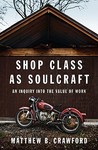
Book Review: Shop Class as Soulcraft by Matthew B. Crawford

Shop Class as Soulcraft: An Inquiry Into the Value of WorkShop Class as Soulcraft: An Inquiry Into the Value of Work by Matthew B. Crawford
My rating: 4 of 5 stars

This book clarifies some of the moral dilemmas intrinsic in a culture that values knowledge work and egalitarian autonomy over work done with physical things and face-to-face with people.  Work has consequences, and work that divorces itself from outcomes hides those consequences.  Knowledge work can be done in a way that keeps consequences to the forefront, and has been done that way in the past, but in our era it generally is not done that way.  This is a *moral* loss for the individual worker as well as the whole society.  I never thought of it that way.

Take this example: as recently as one hundred years ago, bankers were not allowed to operate banks in communities outside of their own.  People had to trust their banks.  Bankers were supposed to determine whether someone was a good credit risk when giving loans.  This knowledge was not just extrinsic, but tacit.  The banker would ask around, talk to local merchants, etc.  He was skilled at reading the responses of others in the community, and therefore able to use his intuitive judgment to reward virtue with a loan.  Nowadays, banks are national and international, loans are bundled and sold off to other entities (even other countries), and the banker is often required to offer loans to those who haven't demonstrated a pattern of trustworthiness.  This degrades the morality of the loan officer.

You can see this in government as well.  (This is my own rabbit trail, not included in the book.)  For instance, in TX right now we are debating whether people receiving food stamps ought to be required to take a drug test.  This is a dilemma for many reasons, but my main problem is how can you know? Obviously, you don't want to help someone who isn't interested in helping himself, but what if it is a family?  What about the rest of them?  And should government even be doing this?  Isn't helping the poor the duty of individuals and churches?  But what if individuals and churches are not involved enough in their communities to understand which individuals need and merit help and which do not?  See the problem?

Anyway, this is a very thoughtful book.  He does not extol the virtues of working with your hands to the exclusion of other work, but he does raise some questions about how we respect or disrespect our own humanity and that of others in the work we do and the work we value.  I have these questions too.  There are no easy answers, that's for sure.

I'm giving it four stars because I did find it difficult to navigate his analogies at times-- I'm not a mechanic. ;)  I was able to get around the difficulties though.  It is an excellent, thought-provoking book.  I recommend it to anyone that is a person, and educators/legislators especially.  Also to people in middle management who wonder why they feel so spiritually/mentally bankrupt.


View all my reviews

Tuesday, September 11, 2012

N&N: Prologue III and IV

I'm back to narrating Norms and Nobility.  (I narrated the Preface and Prologue I and II in June.)


Prologue III

normative= What should be done?
operational= What can be done?

“How can I succeed in an increasingly complicated world?”  This is the question modern educators seek to answer.  The new question feels useful, fits the scientific method, and promises power.  Since the Enlightenment, this question has done battle with the older, normative question:  “What is man and what are his purposes?”  The old has been gradually analyzed into oblivion, while the new has been strengthened by scientific breakthroughs.  Ancient and feudal man understood he had the role of a servant.  To seek anything higher was condemned as foolhardy.  Modern man has broken through that caution and seeks to rule.  This is the aim of modern education.  Educators take things apart and list them for memorization until there is no room in a student's education to ask “What are the implications of this?  How does this increase our understanding of our purposes?”

Prologue IV

Nowadays, schools carry many technologies for finding out what can be done, but no imagination for determining what ought to be done.  Students hitch a ride on a predictable, testable system rather than hiking up the steep mountain to the ideal.  This is now seen in government policy as well as education.  The idea of counterinsurgency during the war in Vietnam was the result of this operational, rather than normative, thinking.  Just because something can be done does not mean it ought to be done.  Another example is teaching communication using technique rather than constant reading, writing and orderly instruction.  (What is the difference between technique and orderly instruction, I wonder?)  Communication is viewed as a skill learned for success, rather than a way to discover man's purposes. Ironically, the author describes the actions of the US in Vietnam in terms that only readers of Plutarch would understand.  I have read just enough Plutarch to recognize the references and grasp shades of meaning, but need to read more to truly understand.  (I also need to research the decisions made by US leaders during that time.  What exactly was the idea of counterinsurgency?  I am sure this is a dumb question for a forty-something American to ask.)

Operational thinking (“What can be done?”) develops a life of its own and strives to exist after its usefulness is over.  This reminds me of the tyrannical brain in A Wrinkle in Time, of government bureaucracies, of parasitic plants and animals in the natural world.  Man, still a servant, serves the Frankenstein of his own making.  Like it says in the Bible, “Choose this day whom you will serve.”  Man will serve something or someone.  Modern man's blindness and pride leads him away from the pursuit of the Ideal Man and toward the machine.

Technique makes man “a more efficient berry gatherer, a more discriminating shell collector, a more willing water carrier,” leaving out any consideration of the human spirit.  Yet the goal of education ought to be the cultivation of the human spirit:  “to teach the young to know what is good, to serve it above self, to reproduce it, and to recognize that in knowledge lies this responsibility.”  Without this, students are left at the mercy of lust and ego.


Wednesday, June 27, 2012

Math and Folk Songs, or Old Joe Clark's House

Yesterday morning Cornflower and I were studying integers: graphing coordinates to form a shape, then stretching, enlarging or reducing the shape by multiplying the original coordinates in different ways.

She had to make a new graph each time, which she found tedious.

She had just began to grumble when she discovered the shape she was forming was Joe Clark's house.

Old Joe Clark, he had a house
Eighteen stories high
And every story in that house
Was filled with apple pie.


(Lyrics adapted to fit Cornflower's graph and preferences.)

All she needed was to remember a favorite folk song and graphing became fun.  I call that true liberal arts education.  =)

(I guess I should point out that I did not make the connection for her.  I wasn't sitting at her elbow saying, "But look!  It's Joe Clark's house!"  I also did not contrive lessons containing folk songs having to do with integers and geometry.  She learned that song through her violin lessons and our folk singing at home.  It just happened to connect to her math today.)

Update 6/29:  Today, after a frustrating lesson on factoring, she exclaimed, "O, how full of briars is this working-day world!"  This is a quote from Shakespeare's As You Like It, and highly appropriate, I thought.

Saturday, June 09, 2012

Norms and Nobility: Summary of Prologue I and II


“What is the solution to the paradox between educating for the world's fight and the soul's salvation?”

This question seems irrelevant in a society preoccupied, not with timeless themes, but current issues of policy. The jargon of experimentation and research suppresses questions of truth and judgment. The expert, secure in his newfangled science, rejects the timeless (and unprovable) wisdom of the ages.

The journalist, speaking in terms we understand, challenges the expert, who responds with more innovation or else advocates a utilitarian 'back to basics' approach. The question of the world's fight and the soul's salvation may be called classical education. Hicks wishes to respond to those who, while they sense the importance of classical education, cannot figure out how to fit it into an industrial society.

(prescriptive: concerned with norms/ideals)
(descriptive: facts without value judgment)

Our ideas about education flow from our ideas regarding man's nature and purpose. The ancients took a prescriptive view embodied in myth: the Ideal Type. This type, both unchanging and constantly refined, was used to instruct students in what they should do. To the ancients, the 'everyman' was an ideal to be attained rather than a random specimen to examine psychologically. They insisted on descriptions that conformed to the ideal, even when those descriptions did not line up with what actually happened.

For instance, it was customary at a Roman funeral for the son to tell idealistic tales of his father's and ancestors' virtues and successes (not necessarily accurate), thereby inspiring young men in the virtue of public service. The modern educator, disliking inaccuracies and denigrating the Ideal Type as arbitrary, rejects the old form of learning and puts in its place a scientific education concerned only with facts.

The ancients saw science as a useful tool in transforming the heart of man rather than as technology for improving quality of life. They believed man himself was responsible for his own folly and needed much more work than the material world, agreeing with Jeremiah that man's “heart is deceitful above all things and desperately wicked”.  However, modern scientists believe evil resides in things outside of man or outside his control, giving rise to the progressive notion that man will be good if technology alters his environment for the better.

The modern world has disregarded the idea of a moral imperative, perhaps thinking it too confining, or else fearing it excludes something important and necessary. However, rejecting the immaterial has narrowed the search for truth and free exchange of ideas in our schools, teaching students to consider only what can be done, rather than what should be done. Modern education, believing man to be a reaction to his environment, has excused him from responsibility for what he knows and focused him on functioning efficiently. The question becomes “How can man get along in this complicated modern world?” and students are taught to desire power rather than truth.

The prescriptive pattern of truth spanned thousands of years and crossed cultural boundaries (Christian, Jew, Roman, Greek), whereas the descriptive pattern is a recent development that excludes non-empirical wisdom and reduces man's thoughts and actions to a reaction against his environment.

Norms and Nobility (again): Preface Summary

When I was a kid, I tried to read Jane Eyre.  It was hard for me, so I would read as far as I could and then set it aside for a couple months.  Then I would pick it up again and read from the beginning and get maybe a chapter or two further than last time.  This continued for years.  Finally, I got all the way through the book, which remains one of my all-time favorite novels.

All that to say I'm beginning Norms and Nobility again.  I got maybe two chapters into it last time.  I have now thought more and learned more.  I am ready to go again.  I don't know if I will make it to the end this go round, but I will try.  I want to understand what he is saying.

I will post my short chapter summaries (short in comparison to the actual chapters).  This is more for my own benefit than anyone else's.  I looked back at my last attempt to narrate Norms and Nobility and can see many failures of understanding.  I expect I will fail to understand again.  But I'll be further down the road than before.  :)

Preface Summary:


David Hicks, a young teacher interested in educational (esp. curricular) reform, wrote the book in 1980. For the next ten years, he read much commentary on the subject and refined as well as validated his ideas. If he had written Norms and Nobility ten years later, he would have been more balanced in his claims regarding the wisdom of the ancients. However, we should remember the author's topic is not “ancient education”, but an ancient ideal known as “classical education”, against which the modern educational establishment is weighed and found wanting. The author wishes to acknowledge the work of other writers such as Mortimer Adler, whose discovery of classical principles is not limited to personal experience.

Hicks promotes learning in context, especially the answering of the question, “What should one do?” as the key to delightful and fit learning (as opposed to memorization of lists of facts). Education being more than the mastery of thinking skills and traditional intellectual ideas, right thinking should lead to right acting. Education must encompass the spiritual and emotional sides of the student as well as the rational, tending toward nobility. Other writers, including Adler, object to this idea of dogma, saying it turns education into indoctrination and puts too great a burden on the teacher.

But skepticism and analysis taught too soon kills the moral imagination and leads to the belief that all ideas are relative. The great books of the Western tradition are worthy, not just because they teach basic intellectual ideas, but because their emotional and spiritual content inspire people to transcend self-interest and act nobly. Hicks believes today's moral relativism and hedonism is the result of educators placing modern scientific principles at the heart of the curriculum, which, while feeding the technological needs of our age, spiritually starves the student. The modern empirical model fails to address the ideal, neglecting urgent moral and ethical questions.

Norms and Nobility focuses more on curriculum, but the author now believes the teacher ought to be the focus of reform. If teachers continually learn and grow themselves, they will motivate students to learn. The general principles outlined in the book (called “normative contextual learning”) are universal, and can be used to develop effective practices specific to the school, the teacher and the student.

In seeking specificity, however, American teachers must be careful not to exclude studies that unify us. We need that common culture in order to properly frame debate between specific groups within the United States. Respect for truth, not regrets or hopes or a desire to build up our students' self-esteem, ought to guide us. As a nation, we have become uncertain of our ideals (“norms”) and abandoned education's ennobling purpose. Without these two things, we cannot bring up free and responsible people.

Saturday, May 05, 2012

Where Do You Find all the Books?

Yesterday, a friend asked me this question in relation to the AO/HEO books we use to educate our kids at home.  This post is a list of recommended strategies for gathering living books.

Many Charlotte Mason educators consider their libraries part of the legacy they will leave their children and purchase the highest quality books they can afford.  Our family homeschools on a shoestring.  I have often bought the least expensive 'average' condition book, but it is worthwhile to get a high-quality hardcover  if you find one at a good price.  

Before shopping for used books, it is helpful to know the jargon.  Thankfully, Abebooks has a glossary of used book terminology and abbreviations.  Keep this page open and use the "find" function on your computer to locate any terms in a listing that you don't understand.

My first stop when looking for books is AddAll.  This website searches the Internet for the lowest price.  AddAll doesn't actually sell you books, but directs you to book sellers online.  Here is a brief list of book selling websites I use:

Amazon Marketplace 

Paperback Swap is an interesting concept.  Users post books they are willing to trade and receive a credit for each book they mail to another user.  The credits are used to choose books from other users.  You can keep a wish list on the site, and they will notify you when books come available.  Twice I have gotten rare, out-of-print AO books for the price of shipping.  I have also exchanged much twaddle for living books. I currently have almost nothing I'm willing to swap, so I just buy credits when my wish list books come up.  Credits are $3.79 apiece.  Receiving credits for books mailed is generally less expensive, as the U.S. media mail rate for books under 1 lb is $2.47.  Usually, one credit gets you one book.  See the website for more information.

(I cannot recommend eBay because I do not like shopping that website.  I get too wrapped up in the competitive aspect, which causes me to overbid.  It is just better for me not to go there.  :)  Your experience may be different.)

I prefer to shop for books online because I can do specific searches and keep myself from getting sidetracked by other goodies that look wonderful but are not on my list.  Shopping for books in real life is often hit-or-miss, which is dangerous for a bibliophile.  When I leave the house to shop for books, I want to come home with books.  If I enter a brick-and-mortar store with a specific book in mind, I will very likely emerge, not with the book I need, but with four or five others that look scrumptious.  This is fine for a family with discretionary income, but for a family on a tight budget, it can seriously mess with next year's educational prospects.  

Having said that, here are some real-life places I like to shop for books:

Half-Price Books
Homeschool book fairs (usually have a couple booths of used and out of print books)
Homeschool support group/co-op used book sales
Barnes and Noble (We view this store more as a museum we visit to remember what new books look like, but they have a nice collection of reasonably priced classics in hardcover.  Some are abridged, so do your homework.)

As a homeschool buyer of many years, I can honestly say it is less expensive in the long run to purchase books on the purchasing list online, even at slightly higher prices (shipping, you know) than to purchase ten amazing books just discovered at a brick-and-mortar store or homeschool used book sale.  The exception, of course, is if you find a thrift store or flea market practically giving books away for under a dollar.  These places exist.  One of the thrift stores near us sold books for 25 and 50 cents for years.  If you find a store like this, shop every week until they come to their senses.  ;o)  Libraries sometimes literally give books away, too.  Here are a few places to check for these free or almost-freebies:

Thrift stores
Flea markets
Libraries
Garage sales

Half-Price Books warehouse is another place to get free or almost-free books.  These are clearing-houses for books that do not sell in the stores.  Homeschool moms qualify as teachers at the warehouse in our area.  If you are a teacher, you may attend their clearance events in which they give away books for free or almost-free.  You have to sign an affadavit stating you will not attempt to resell the books.  I got some of my best books at one of these events.  But it can be a mad rush of people jostling for books, so beware.  This is the reason I only went once!  Also, bring boxes and a hand truck and prepare to stay to the bitter end.  People take entire shelves of books, sort through them, and put back what they do not want.  Sometimes what they do not want are classic works of natural history and science.  You can find great things if you are patient.

Borrowing books can also be an option if you know other CM homeschoolers in your area.   Many CMers are protective of their books, and with good reason.  (See "building a legacy for their children", above.)  Borrowers do not always return books, and lenders do not always remember who has their loaned books.  I have been on both ends of this trouble.  I lost several lent books over the years, some of which I just realized were missing this year when I needed them for my youngest daughter's schooling.   I had to repurchase them.  But I am not innocent, oh no.  Only last week I almost gave away a book I borrowed over three years ago! 

With all its pitfalls, borrowing and lending can be a great way to share books if a few rules are followed:

1)  If someone lends you a book, respect the honor conferred upon you and return it as soon as possible,  

2) Only lend books you don't mind losing, and

3) Keep records of borrowing and lending so you do not forget.

The library can be a great borrowing resource, too.  Our library expanded into a new building (and a new purchasing budget!) a few years ago and actually requested that patrons make book purchase suggestions.  Homeschoolers took them up on this opportunity!  Even if your library is not asking, you can request that they look for certain books when they have a purchasing budget.  The worst they can do is say no.  We live in a large metro area and have cards to three different library systems.  If one library doesn't have what we need, another may.  Also, many people use inter-library loan, and, while I haven't ever used it, I have heard that it is a good way to borrow rare books.  The drawback to using the library is that the books must be read more quickly than is usual in a CM education. 

Purchasing books for Kindle and other eReaders is a new trend in CM homeschooling.  It is affordable and convenient.  You do not have to own a Kindle to use a Kindle book.  You can download them onto your PC.  Also, quite a few classic books are available to download for free on the Internet.  Some of these books are indicated with hyperlinks on the Ambleside Online website.  At our house, we use a lot of free-on-the-Internet books for the cost-savings, but we prefer paper pages and hard covers and purchase as many hard copies as we can afford.  We have a running joke that when the electrical grid goes down, we want to be like the monks of the Dark Ages, preserving beauty and knowledge with our paper books... not that we think the grid will go down any time soon.  ;o)  Doom and gloom aside, here is a sampling of links for downloadable ebooks:

Ambleside Online (online books indicate with hyperlinks which lead to other websites)
Amazon (do a search for "free kindle books")

These are a few strategies I use to find books for my kids' education.  What book-finding tips would you offer a lately-come-to-CM mom?

Friday, June 03, 2011

One More Student Whisperer Post

I thought I was done with the Student Whisperer, but the following point keeps coming to mind.

In the "personal experience" section, Ms. Earle talks about going to a simulation as a college student. (A simulation is some kind of simulated event-- in the book, she discussed a meeting-of-nations simulation, I think. It sounds sort of like debate, but deeper and in a variety of contexts.)

Anyway, after she came through the simulation, she talked about the constant tension, the man-on-the-ground immediacy of what was happening. Decisions had to be made quickly. There were so many people lobbying in different ways... well, let me just quote her:

"One girl said she was used to being in control,and when she realized she had no control over the way the simulation was going, it scared her."

Okay. Life is like that sometimes. Not everyone is like you. Some folks will behave in ways you cannot predict. Kids have to be prepared for it. Studying the Bible and history and literature frames our minds to respond properly in real-life experiences, which for students may come through sports, speech and debate, volunteering, part-time jobs, and theater and music collaborations and performances.

A friend of Ms. Earle's said the simulations helped him prepare for a tense situation later in life. He was in a condo association meeting and the majority shareholder became unreasonable. Her friend was able to keep his cool when the situation spiralled out of control. He helped resolve it.

We hope our kids will be able to handle situations like this by the time they leave home. Getting them out in real-life situations is a natural step after steeping them in the right books. I have a tough time with this one, because I would rather stay home and read and play music and watch movies with my family. So I post this as a reminder to myself that properly chosen extracurricular activities are a vital part of my kids' education.

(One more thing to remember is that experiences can only be called "real-life" if we allow the kids to experience them. If we engineer our kids' experiences so they don't have to deal with unpleasantness, that's not real life. We have to use discernment in order to decide if we need to intervene or not, but as they get older, they ought to have their experiences less and less diluted by their parents.)

Thursday, June 02, 2011

Here Be Dragons

This is probably my last post on The Student Whisperer. I plan to go through the exercises in the second half, but I won't blog about them. Before leaving this book (blog-wise, at least), here are two final ideas I appreciated:

Students go through phases.

I won’t give details on the graph she uses to show the differing needs of students. (Buy the book!) But students’ needs change. Also, a particular student may cycle through phases, go through them out of order, and go through a phase more than once. This is important to remember. People are quirky. We aren't machines. We don't necessarily follow a straight line of development. Sometimes we need what my friend, Javamom, calls “space and grace”. Sometimes we need help structuring our work. Sometimes we need to hear a hard truth. Great teachers are sensitive to the changing needs of their students.

There are mountains to climb.

Learning can be delightful, but it can also be difficult. I sometimes forget this because didn’t Miss Mason say, “Studies serve for delight”? (Well, it was actually Sir Francis Bacon, but she quoted him.) If we aren’t constantly delighted, maybe we are doing it wrong… But I don't think so. We get inspired. We are delighted. We become hungry for mind-food. However, it isn’t necessarily easy to digest. Ms. Earle talks about a time in a student’s life after the novelty wears off and the work begins. The student still wants to learn, but it is definitely hard work, and sometimes he may think about giving up. I have seen my kids go through this. Sometimes a break is in order. Sometimes we need to seek out additional help. Sometimes the student just needs to push through. At times like these, I stock up on chocolate and I-love-you stickers. ;o) We pray. Also, we talk about the process. We try to discern the roadblock and get over or around it. This poem sometimes helps:

Above all, trust in the slow work of God.

We are quite naturally impatient in everything
to reach the end without delay.

We should like to skip the intermediate stages.

We are impatient of being on the way
to something unknown,
something new.

Yet it is the law of all progress that is made
by passing through some stages of instability
and that may take a very long time.


And so I think it is with you.

Your ideas mature gradually. Let them grow.

Let them shape themselves without undue haste.

Do not try to force them on
as though you could be today what time
-- that is to say, grace --
and circumstances
acting on your own good will
will make you tomorrow.

Only God could say what this new Spirit
gradually forming in you will be.

Give our Lord the benefit of believing
that his hand is leading you,
and accept the anxiety of feeling yourself
in suspense and incomplete.

Above all, trust in the slow work of God,
our loving vine-dresser.

Amen.


-- Pierre Teilhard de Chardin

Math and the Student Whisperer

In the “personal experience” section of The Student Whisperer, Ms. Earle details a conversation she had with a student in which she explains that math is more than the systematic concepts we are taught in our textbooks. It is a philosophical search for truth. She is right. So much is left out of math courses these days-- ideas that would humanize mathematics for those that struggle.

At our house, we use math textbooks and systematic curriculum. I teach concepts in a logical progression. But we also read living math books as much as we can, eventually including Euclid and Newton. (I even found a book of math poetry, ha!) I am NOT a math person, but as a result of reading some of these books, I have a compelling desire to push through my computational and conceptual issues so that I can understand all aspects of this search for order in the universe. Because God likes math. How about that?

Monday, May 30, 2011

Inspiring Learners

Three more ideas from The Student Whisperer-- and now I must clean my house! More later.

1. We learn more effectively when we are inspired by love than when we are forced or manipulated: This is a difficult concept to delineate, because sometimes we are easily manipulated when we love someone or something. But real love of learning is a love of truth. It is turning away from ignorance because we want to know the truth, as much of it as we can possibly grasp. It is a sort of repentance. We realize we don’t know, we wonder, and we want to learn. In this book, there is so much focus on formal mentoring and the mentee’s purpose in life that I see two dangers-- 1) of thinking the mentor’s inspiration is all-in-all, and 2) of focusing solely on the student’s desire to become his “real self”. The focus should not be the mentor OR the mentee—it should be our love for God, manifested in our desire to know the truth of whatever we are learning. I agree that our own gifts, talents and passions should be considered. I agree that we can be and are inspired by others in our search for truth. But the focal point should be God, not ourselves and not someone else. I have witnessed people completely swallowed up by the big personalities of others. The only Person that ought to consume us is the Lord. And those of us in positions of authority (either official or conveyed by the trust of another person) must be wary of exerting undue influence.

2. The government cannot legislate education: “The educational system seeks a quantifiable, measurable system, while year after year parents, students, teachers and observers leave frustrated that schools so often fail to deliver that spark, that flow, that light that defies virtually all types of measurement…Great education is not about institutions or bureaucratic policy. It is about individuals, one by one, becoming who they really are.” Ms. Earle says in another place that the best thing legislation can do is secure a proper atmosphere for learning, ensure the freedom to learn. CM quoted the Gospels to illustrate this code of education: “It is summed up in three commandments, and all three have a negative character, as if the chief thing required of grown-up people is that they should do no sort of injury to the children: Take heed that ye OFFEND not––DESPISE not––HINDER not––one of these little ones.” Where public (and private) school systems fail is in trying to legislate the learning part. That would best be left to wise teachers “on the ground”, so to speak. They can see what is needed and will provide it naturally if they are allowed, something a system or bureaucracy simply cannot do. This begs the question of teacher education. I think the homeschooling movement shows, anecdotally at least, that even ‘untrained’ teachers can learn to ‘stand or fall on their own efforts’. And more often than not, when unhindered by regulations, they find their feet and passionately stand. (And here is a caution for homeschoolers as the movement matures: Do not desire to return to Egypt, and do not lay grievous, legalistic burdens on young families. As long as we can, let us educate with all the glorious, inefficient, individual liberty God gave us.)

3. Great mentors inspire by example: Passion and devotion are catching. What are you passionate about? What are you devoted to? ;o) CM called this Mother Culture (we have buzzwords too) and encouraged moms and teachers to keep up their own studies. I have seen my kids take something up simply because I am keenly interested. For example, my 10yo has an excellent ear and has been known to 'sound out' entire sections of piano pieces I am learning. Sometimes I stop her because she hasn't gotten far enough in her technique to execute those pieces properly. She mustn't develop bad habits. But I also have an obligation to help her on her way, as far as I can, and as quickly as she would like to go. Okay, maybe not quite as quickly as she would like. I want her to have a well-rounded education, and not work on music to the exclusion of other things she ought to know. This means we have to moderate her music learning so that, even if it is a large part of her learning, it is not the only thing she learns.

Mentors

Keeping in mind the caution to let systems be servants rather than masters, here are some truths I pulled from The Student Whisperer. I have more principles to pull out of the book-- lots of good stuff in there-- but I want to keep my posts somewhat short, so I'll continue in installments. (For previous posts, type "student whisperer" in the search field in the top left corner of this page.)

1. We have mentors from a variety of sources throughout our lives: In the comments of a previous post, my friend Kay brought up a point that fits well here: “We should have many teachers and read from many books (also our teachers) and set out that full banquet before us and our children.” It appears that Ms. Earle feels the same way. In one place, she says, “Stories tell it all,” meaning that we are taught truth and virtue by the stories we read, whether of history or philosophy or science or imaginative tales. I want to be careful to point this out, because in the “application” portion of the book, she gets very particular about formal mentoring, and it would be easy to assume that one person-- a formal mentor-- ought to be a person’s Guru. That would be a bad thing, unless that Person is Christ.

2. Real-life mentors can help you see past your blind spots: Ms. Earle challenges her readers to think about the mentors in their own lives, and while I have not actually done any of the activities in the book, I did consider my own mentors. When I think about it, I am filled with wonder at my life. I homeschool my children and run my own business, two risky endeavors. But it is because of my real-life mentors—wise, undaunted people who speak into my life. They encourage me to take risks because I am a cautious person by nature. I also tend to be cautious about influencing my children. I don’t want them to feel that they have to ‘be’ something for me. I am not God, and cannot see all facets of their personalities and abilities, all the possibilities for their lives. But at the same time, I want to be that wise, undaunted person that encourages them to grow into the full-fledged people God intended them to be. I want to help them see past their blind spots.

3. Children (and adults, for that matter) “must stand or fall by their own efforts”: In the era of participation awards, the Nanny State, and corporations that are “too big to fail”, I am afraid we have sadly forgotten this principle. The above quote is from Charlotte Mason, but Ms. Earle echoes it in her struggle to teach her son to pick up his belongings. He finally succeeds when she allows him the freedom to fail. This does not mean that we throw our kids to the wolves. But we mustn’t stand in the way of logical (and sometimes natural) consequences.

4. Peers are mentors: This is a fact, for good or ill. Our older kids have a natural desire to be around friends, and their peers WILL influence them. The pressure our kids feel from age mates can be used “for goodness, for nobility, for excitement to learn” or “to fit into the crowd or to do drugs, or to waste time…” We adults must help to establish a peer environment “where there is pressure to become someone good, knowledgeable, courageous and wise. Where the pressure is love.” This is one of the main reasons I wanted to read this book. I want to learn how to establish proper atmosphere for my older kids and their friends.

Saturday, May 28, 2011

Sally Albright and The Student Whisperer

The labels are still bothering me. I keep thinking about the Nora Ephron movie "When Harry Met Sally". (This is one of my favorite movies, although I have not let the kids watch it. Some adult themes.)

You know that scene when Sally calls Harry and she is just crying her eyes out? Her ex-boyfriend is marrying his new girlfriend, and the news devastates her.

" He just met her... She's supposed to be his Transitional Person, she's not supposed to be the One!" she sobs.

This is a moment of truth. She thought she had the 'Love-and-Marriage System' figured out. But her boyfriend, despite breaking the rules, finds love and marriage. Shock. She comes to the devastating (but ultimately liberating) realization that love and marriage cannot be confined to a system.

This truth is also communicated in the "old married couples" vignettes throughout the movie. I love that movie.

Education, like love and marriage, cannot be confined to a system.

And that is what bothers me about those labels. I don't know how 'systematic' The Student Whisperer is, and I like a lot of what I am reading, but I also get the sense that if I followed these teachings wholeheartedly, I would become the Sally Albright of education and eventually sob to the Warrior Poet, "She just crossed The Chasm... her Mentor's supposed to appear... she's not supposed to be facing the Ultimate Test yet!"

Which, of course, reveals that I do not understand these terms very well. But that is what I would do. Take a list of rules and run with it. Don't we want a magic pill, a formula we can plug in and out pops this amazing adult? But human beings are not machines. Contrariwise, as Tweedle Dee said. They stubbornly insist on being quirky. When I really think about it, I wouldn't change that. I love quirky people. But they refuse to fit neatly into systems, and that makes the job of educators more difficult. (Also more exhilarating.)

I have already played the role of Sally Albright more than once in my career as a mother, and I can finally recognize the looming temptation when I see it. Not going there.

In my next post, I will list all the things I like so far about this book. I do want to incorporate some of these ideas into my life as a mom and teacher. But here is a danger of method degenerating into system, and I want to be sure and think it through first.

Friday, May 27, 2011

Narration II: The Student Whisperer

This book has got me thinking. I am now almost through Chapter 4. Honestly, I think the book is valuable for the journals alone. But some of the educational philosophy stuff has set off warning bells in my mind.

Her idea that every student ought to study for eight to twelve hours per day by the age of twelve or thirteen bothers me. It seems to focus on books to the exclusion of all else. I can’t be happy with it. There needs to be time to take walks, to serve with your hands, to develop relationships with the people around you. I do think teenagers should do hard things, and have rigorous studies, but I’m kind of on the side of the parent who pulled her student out of the school because he was studying too much. It sounded like his life was out of balance.

Just because the Founding Fathers went to university at the age of twelve or thirteen doesn’t mean it is the right thing to do. There were some flaws in the thinking of the Enlightenment, such as the idea that rationality was supreme, Reason was everything. Imho, their emphasis on rationality and reason is one of the reasons philosophy went off the deep end in the 1800s with Transcendentalism.

Ask John Quincy Adams about his family life. He was an amazing person, and I am so glad the U.S. had him, but his life was not healthy. Can a person be a statesman and have a healthy life at the same time? For some reason, I think of Theodore Roosevelt when I ask this. I have only read a couple of his biographies, but he seems to have had balance as well as passion. He DID study and read and write a lot, but he disciplined his body so he could get up early and have plenty of time for other things as well, including exercise, family life, nature, music, art, service to others, developing practical skills, etc.

I think this kind of life has to be built up gradually. Teddy Roosevelt did that, beginning with physical exercise and study as a young man. I don’t have a problem with my students studying eight to twelve hours per day when it is necessary (and my high schooler does study that much at times), but there has to be time for the development of the rest of the person.

Back to the danger of deifying reason-- I do think that reason is important, but it is a servant to the ideas we embrace, whether those ideas are good or bad. The student’s job is to accept right ideas and reject wrong ones, prior to letting reason loose on them. (I am a little sketchy on how this can happen prior to reasoning them through, but it has to do with emotional attachment and making sure your assumptions line up with your belief system.) I can tell that Tiffany Earle understands this from her discussion of philosophy in her academic journal excerpts. However, I think there is a danger of ‘book learning’ being emphasized too much

Again, The Student Whisperer assumes knowledge of TJEd, and I haven’t read the book. I am speaking from a position of ignorance. I am going to ask a friend if I can borrow it.

Also, after sleeping on the first three or four chapters, I wonder how far a mentor can go before his or her inspiration becomes the ‘suggestion’ that CM denigrated. We don’t want to be manipulative. We are to feed the student on books and things (ie., nature objects, etc.) and then draw out what is already in the student that is capable of relating to those ideas and objects. I am wary of a mentor disrespecting the personhood of the child. It is too easy to become a guru. Don’t get me wrong, I love the idea of mentoring. I want to inspire students to something better. And I want someone to inspire ME. But I want us to think of the Lord first when we hit a roadblock. Tiffany Earle does talk about getting on your knees when you are unsure what the next step is, so I think she agrees, but this book places such importance on mentoring that it would be easy for a person to read the book and get the wrong idea. Again, I speak in ignorance of TJEd. I’ve got to get that book.

Can a person be a great mentor and avoid becoming a guru? Where is the line between inspiring and controlling? (I am using the term’s negative connotation, such as the leader of a cult.)

It does seem as if the students own their process of education in this method, although Tiffany Earle’s high school success (pre-TJEd) was motivated by emulation. Her biggest “award” on graduation day, although she received more scholarships and recognition than any other student at her school, came from the realization that one of her teachers had treated her with cordial respect not because she was smart, but because of herself. She told this story for a reason—it is important to her that students be respected not for their academic achievements, but because they are persons. I agree with that.

I may simply be responding to the possibility that this much power is capable of corrupting the mentor. Anyone in a position of profoundly influencing another person’s life has to be wary of their own weakness, of the possibility of corruption.

On the other hand, lack of wise guidance leaves young people at the mercy of their own desires, whether for good or ill. They need mentors to stand for right and model goodness. This book further illuminates how challenging it is to love and counsel teens. I was hoping it would help, not raise more questions! (It probably will. I'm only on Chapter 4.)

First narration here.

Tuesday, May 03, 2011

Reaching

My piano teacher was serious.

When she said I was to memorize my piece for the recital, I thought it was a suggestion-- that it would be nice if I could, but wasn't really required. I had to take a break from lessons for about a month, and when I went back a couple of weeks ago, I explained that I don't memorize pieces. I had tried to memorize the Brahms, but it wasn't working. Nope, I am not a memorizer. Some can and some can't, you know. I'm more the 'great sight-reader' kind of piano student, not the 'great memorizer' kind.

She said, "Oh, well, I never let my students perform their solo pieces with sheet music."

Okay. Well, I don't have to do the recital, right?

"We could do some of these duets instead. You don't have to memorize ensemble pieces." And she pulled out these little duets. After I had worked so hard on the Brahms and it sounded so grand. She really wasn't going to let me play my piece, and she wasn't letting me out of the recital, either.

I went straight home and memorized the first three pages over the weekend. I used every stray bit of time I could find after doing my regular wife-and-mom-stuff.

Until the Brahms, I had only memorized two piano pieces in my life. As the material got longer and tougher, my childhood teacher gave up on making me memorize. I am very good at sightreading, but terrible at memorizing.

Something happened as I worked to memorize the Brahms, though. I began to look at the music in a different way, to apply my knowledge of composition to comprehend the work more fully. It became more my own mind-property, if you know what I mean. I understood it better because I had to think it into my fingers without the symbols in front of me.

At the next lesson, I sheepishly told my teacher it turns out I can memorize, and I hope to get the entire piece by memory before the recital. She said it would be okay to do excerpts. I want to do the entire thing. She gave me until Friday to memorize all of it. I am working sooo hard to memorize it. Only fifty-six measures to go.

Being a student myself makes me sympathize with my kids as students, but it also reminds me to be firm. So much growth takes place when we are required to reach above what we think we can do.

Tuesday, February 08, 2011

More Understanding Than All My Teachers

I have heard it said that a student is only as good as his teacher; but that has never rung true to me. The Psalmist reaches higher: "I have more understanding than all my teachers: for thy testimonies are my meditation."

I found another quote today that shows the 'how' of a student advancing past his teachers.

"Do not seek to follow in the master's foosteps; seek what he sought." --Vladimir Horowitz, quoting a Chinese proverb.*

This idea fills me with hope. I want to seek what is worthy, and teach my students to reach beyond what I know. I want them to seek the Lord in everything they do, whether that involves finding Him in the expression of a piece of music, or the rationale of a scientific conclusion.

*from _Great Pianists Speak for Themselves, Vol. 1_ by Elyse Mach

Sunday, September 12, 2010

The Why of English (and Western) History

In this book I am trying to give you only those events of the past which can throw a light upon the conditions of the present world. If I do not mention certain countries, the cause is not to be found in any secret dislike on my part. I wish that I could tell you what happened to Norway and Switzerland and Serbia and China. But these lands exercised no great influence upon the development of Europe in the sixteenth and seventeenth centuries. I therefore pass them by with a polite and very respectful bow. England however is in a different position. What the people of that small island have done during the last five hundred years has shaped the course of history in every corner of the world. Without a proper knowledge of the background of English history, you cannot understand what you read in the newspapers. And it is therefore necessary that you know how England happened to develop a parliamentary form of government while the rest of the European continent was still ruled by absolute monarchs.

--from The Story of Mankind by Hendrick Van Loon (Chapter 45)

Monday, April 26, 2010

N&N: That Which One Thinks is True

David Hicks uses the word, 'dogma', in his book. I keep bumping up against it in an uncomfortable way. What exactly does it mean? And in what sense does he use it? And why am I uncomfortable with that word in the context of education?

dogma:
1. tenet, a religious doctrine that is proclaimed as true without proof
2. a doctrine or code of beliefs accepted as authoritative.

dogma:
1 a : something held as an established opinion; especially : a definite authoritative tenet b : a code of such tenets c : a point of view or tenet put forth as authoritative without adequate grounds
2 : a doctrine or body of doctrines concerning faith or morals formally stated and authoritatively proclaimed by a church

The word is from a Greek root meaning, "to seem good, think". Hmm.

Here are some quotes from N&N. I think Mr. Hicks is using the word in the sense of 'authoritative code of beliefs':

"I have differed from many modern writers on education by insisting upon the necessity of dogma..." (p. vi)

"Both an elaborate dogma and a man, [the Ideal Type] defied comparison with any man, yet all men discovered themselves in it." (p. 4)

"Like the thinker whose brilliance we universally acclaim, Alfred North Whitehead, we have cultivated a perverse form of modesty and self-deception that, in the absence of dogma (the working yet scientifically undemonstrable hypotheses of the old civilization), has allowed us to forget who we are and what our purposes are, as well as to neglect to teach those lessons to our children." (p. 10)

"Classical education presents the right way, not with the intention of stifling future inquiry, but as a necessary starting point for dialogue. In this sense, dogma can resemble art: it confronts man with some truth about himself, a kind of truth that might have taken him a lifetime of error and misdirection to arrive at for himself, but ultimately, a truth he must test in his own experience of life if he is to appropriate it for himself and benefit from the confrontation." (p. 19)


So-- Mr. Hicks believes dogma is necessary in education. The Ideal Type is dogma. So were the "working yet scientifically undemonstrable hypotheses of the old civilization". Without it, we do not know who man is, and what his purposes are. And dogma can behave like art.

I think I am uncomfortable because I do fear indoctrination, especially if we are talking about education in a larger sense than what I am doing at my house with my own kids. Obviously, I think dogma (Christian dogma, to be specific) is a necessary component of education-- one of the reasons we homeschool is because we have strong convictions regarding "what we think is true". But who picks the dogma for institutional schools? The parents? The school board? The state or national government?

Can dogma be broad enough to be universal and not infringe on religious freedoms when the state runs government schools-- and yet still be that spirit that confronts us with who we are and what we ought to do?

C.S. Lewis, in his book, _Mere Christianity_, talks about certain laws that are accepted by almost every human culture, even the remotest. The fact that so many different cultures have such similar principles, Lewis says, is proof (in the sense of classical inquiry rather than scientific) that a universal code of ethics exists. This is why we can use Greek and Roman myths, African "Anansi" legends, and old European fairy tales as 'organizing stories' for our young folks-- these stories embody universal values.

Could this code be used to form dogma for education, even in a nation in which the definition of 'religious freedom' is being debated? I know some folks have tried (William Bennett comes to mind). Is that what Mr. Hicks is talking about? Is it enough?

Update: It occurred to me as I woke up this morning that CM's student's motto and 20 Principles are dogma, although she did call on the science of her day as proof for some of her principles. She had tremendous respect for and hope of science, it seems. And she also understood the educational necessity-- indeed, the human necessity-- of addressing the questions, "What is man? and what are his purposes?"

"I am, I can, I ought, I will." This was the motto she gave us. I am a human being, one of God's children; I can do right by my fellowmen and by myself; I ought so to do and God help me, I will so do. Is this not a great message she has given us?

--Michael A. E. Franklin, one of Charlotte Mason's students; from In Memoriam

N&N: The Shape of Education

Form is the necessary precondition for all experience and expression, perception and comprehension.

--David Hicks, Norms and Nobility, p. 18.

***


Two criteria for the classical curriculum:

1. Logical methods

2. Okay, I have to say I can't figure out the second criterion. It has to do with general curiosity, beauty, and ethics. It's the criterion that broadens, while the first one narrows. This second one is the 'spirit' part, while logic is the 'format' part of classical inquiry. It is what CM meant when she said, "Education is a life." It is ideas. I think.