Showing posts with label Books. Show all posts

Saturday, July 20, 2013

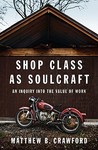
Book Review: Shop Class as Soulcraft by Matthew B. Crawford

Shop Class as Soulcraft: An Inquiry Into the Value of WorkShop Class as Soulcraft: An Inquiry Into the Value of Work by Matthew B. Crawford
My rating: 4 of 5 stars

This book clarifies some of the moral dilemmas intrinsic in a culture that values knowledge work and egalitarian autonomy over work done with physical things and face-to-face with people.  Work has consequences, and work that divorces itself from outcomes hides those consequences.  Knowledge work can be done in a way that keeps consequences to the forefront, and has been done that way in the past, but in our era it generally is not done that way.  This is a *moral* loss for the individual worker as well as the whole society.  I never thought of it that way.

Take this example: as recently as one hundred years ago, bankers were not allowed to operate banks in communities outside of their own.  People had to trust their banks.  Bankers were supposed to determine whether someone was a good credit risk when giving loans.  This knowledge was not just extrinsic, but tacit.  The banker would ask around, talk to local merchants, etc.  He was skilled at reading the responses of others in the community, and therefore able to use his intuitive judgment to reward virtue with a loan.  Nowadays, banks are national and international, loans are bundled and sold off to other entities (even other countries), and the banker is often required to offer loans to those who haven't demonstrated a pattern of trustworthiness.  This degrades the morality of the loan officer.

You can see this in government as well.  (This is my own rabbit trail, not included in the book.)  For instance, in TX right now we are debating whether people receiving food stamps ought to be required to take a drug test.  This is a dilemma for many reasons, but my main problem is how can you know? Obviously, you don't want to help someone who isn't interested in helping himself, but what if it is a family?  What about the rest of them?  And should government even be doing this?  Isn't helping the poor the duty of individuals and churches?  But what if individuals and churches are not involved enough in their communities to understand which individuals need and merit help and which do not?  See the problem?

Anyway, this is a very thoughtful book.  He does not extol the virtues of working with your hands to the exclusion of other work, but he does raise some questions about how we respect or disrespect our own humanity and that of others in the work we do and the work we value.  I have these questions too.  There are no easy answers, that's for sure.

I'm giving it four stars because I did find it difficult to navigate his analogies at times-- I'm not a mechanic. ;)  I was able to get around the difficulties though.  It is an excellent, thought-provoking book.  I recommend it to anyone that is a person, and educators/legislators especially.  Also to people in middle management who wonder why they feel so spiritually/mentally bankrupt.


View all my reviews

Sunday, June 02, 2013

Where We Are

(It is tiresome to read someone's apology for not posting and resolution to write more, so I won't say anything about my hope that I will be a more dedicated blogger this summer.)

I mostly want to write about where we are in our homeschooling.  My two youngest are still finishing this year's schoolwork, but Aravis has officially been handed her diploma and is now a high school graduate.

Mariel and Cornflower will do math all summer.  We are also doing a neurodevelopmental program.  I am learning more about how the brain works, which is very interesting: visual/auditory processing, hand/eye/ear/foot dominance. That sort of thing.  It goes on for four months and then we will see whether the results are worth the effort.  I mostly hope it will help with short term memory, organization and sequencing.  The girls are being good sports about it.  I promised Cornflower we would get her some workout clothes. :)

We take daily walks as part of the program.  We are going to get pedometers and once we have walked a total of 450 miles, we are going to visit friends that live 450 miles away.  That will be our reward for sticking it out.

Our work has changed too.   The Warrior Poet is working in a warrior shop now.  He sells guns and that sort of thing.  It's more his style than selling soap.  He is happy. This past year has been confused and frustrating, like a whirlwind, but the Lord has set us down in a good place.

I teach more private music lessons now, three afternoons/evenings per week.  I enjoy teaching music.  Funny how I always feel renewed after working with individual music students for a few hours.  I must be meant to do that sort of work.

We are still adjusting to the odd times of the Warrior Poet's retail and my after-school teaching schedule, looking for those golden hours when we are all available for family time.

Aravis still works at the Walgreens on the corner, although that may change once she gets her schedule for her first term at the university.  Mariel just started a job as car-hop at the nearby Sonic.  Cornflower aspires to work as well, and actually did have a twice-a-month gig this school year, teaching music-readiness activities to two of the brightest and sweetest little boys you ever did see.  They are off for the summer, but will begin again in the fall.  In the meantime, she plans to volunteer at the library.

Here are the books we read this year. An asterisk (*) means we are still working on it. A bold title is one I read also.  Italics means we read it together (at least some of us).  I am not including outside courses or curriculum-type things.  These are real books we read. We also did ALEKS math, Apologia sciences, Lost Tools of Writing, the Hillsdale online Constitution course, fine arts co-op, an outside Spanish class (Mariel), dual credit courses (Aravis), a personal finance course (Aravis), drama club, and orchestra/music lessons (Cornflower).  And we read the Bible together every school day.  Now.  These are the books we read:

Aravis (a cobbled-together Year of Ancients)-

The Iliad
The Epic of Gilgamesh
Vanity Fair
The Greek Way
The Roman Way
The Portable Greek Historian
The Portable Roman Reader
Heroes of the City of Man
The Christian Imagination
The Odyssey
Quo Vadis
The Blood of the Moon


Mariel (AO/HEO Year 9)-

A History of the American People
Hamlet
Founding Father: Rediscovering George Washington
*How to Read a Book
Land of Little Rain
Marie Antoinette and Her Son
Miracle at Philadelphia
Mozart (biography)
Ourselves
Salem Witchcraft Trials
She Stoops to Conquer
*Simond's History of American Literature
Reflections on the Revolution in France
Tale of a Tub
The Four Loves
*The God Who is There
*The Jesus I Never Knew
The Problem of Pain
The School for Scandal
The Sea Around Us
The Vicar of Wakefield
*Undaunted Courage
*Waverly
Poetry of Byron, Pope and Phillis Wheatley

Cornflower (AO Year 6)-

*Be Ready to Answer (updated version)
God's Smuggler
Age of Fable
Albert Einstein and the Theory of Relativity
Animal Farm
Augustus Caesar's World
Carry a Big Stick
Genesis: Finding Our Roots
It Couldn't Just Happen
*Little Women
*Never Give In
School of the Woods
Secrets of the Universe
Story of the Greeks
*Story of the Romans
Story of the World Vol. 4
*The Bronze Bow
The Story of David Livingstone
Poetry of Alfred Noyes and Robert Frost

I've been feeling kind of down that we aren't finished with school yet.  That is a common small-talk question currently: "Are you finished yet?"  Well, no, we are not.  And it made me feel somewhat down, like we hadn't worked hard enough to get things done on time.  But we did a lot.  Maybe I shouldn't plan so much of everything next year.

Saturday, April 06, 2013

Book Review: Beauty Will Save the World


Beauty Will Save the World: Recovering the Human in an Ideological AgeBeauty Will Save the World: Recovering the Human in an Ideological Age by Gregory Wolfe
My rating: 4 of 5 stars

I liked this book.  I especially liked the chapters on authors and political figures. I think my favorites were Wendell Berry and Russell Kirk, because I was fascinated with them to begin with, but didn't know much.  I also liked the section on Flannery O'Connor, because it helped me understand why I can't get comfortable in her stories.

Parts of the book were rough going.  Sometimes I had trouble following his arguments.  Other times I struggled with my own lack of theoretical literary knowledge.  I didn't get some of his terms, but chose to let them fly by rather than looking them up. I did not want to get bogged down with the dictionary.

I liked the autobiographical bits.  They made the book more personal and were just plain interesting.  I like knowing how a person's experiences have colored his ideas.


View all my reviews

Thursday, March 14, 2013

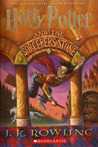
Review of the Harry Potter Books


Harry Potter and the Sorcerer's Stone (Harry Potter, #1)Harry Potter and the Sorcerer's Stone by J.K. Rowling


I read the series over Christmas break because Mariel had read it and I wanted to have conversations with her.

The first book is not very good writing. The writing and storyline get better as you read through the series, although it always seems somewhat self-conscious.

First... it's about witchcraft. I have definite philosophical/religious problems with that. Setting that aside, and looking at it as a parallel universe, it turns out to be a great story. I admire Harry Potter. He feels real, he faces difficult decisions, and he gradually comes to nobility.

Rowling is good at character development. I would be reading along thinking, "Ho hum, your basic tween/teen series with all the repetitive 'novelty' of that genre," then a character would take a turn that I didn't expect. This happened over and over. She makes you realize that it is easy to misread a person's actions-- that a bad guy may not be bad at all, you are simply taking his actions at face value.

I am noticing these characters more and more in current literature. I guess you call them anti-villains or anti-heroes, or what-is-this-person-a-good-or-bad-guy. Take Elphaba in the musical, "Wicked". (Also a witch, btw.) She seems to be the dysfunctional bad guy in Oz. Glinda appears to be the good one. Then Glinda seems to be the legalistic status-quo bad guy and Elphaba is the misunderstood, mistreated misanthrope who becomes noble. Then at the end they are both noble. Elphaba saves her world, and nobody ever knows.

Getting back to the Harry Potter series: Rowling is very good at this. What does this do for us as human beings in search of truth? I think it shows us that you NEVER know. You really never know. You have to judge people by their actions because that is what you see, but just remember... you never really know. God knows. We don't. I think it is a good reminder.

So I ended up liking the series. The characters were real and noble. I probably would wait to let students read the series until at least middle school.


View all my reviews

Saturday, October 01, 2011

Annie Dillard and Sorrow

Yesterday while weeding, Cornflower and I found the skeleton of a mouse.  I suspect it died of thirst.  It has been so dry this year.  The ground is cracked, the leaves brittle, the wildflowers almost nonexistent.  Fire has been a Texas norm this summer, with its attendant loss of cherished and even vital possessions.  The natural world affects us.
The picture of fecundity and its excesses and of the pressures of growth and its accidents is of course no different from the picture I painted before of the world as an intricate texture of a bizarre variety of forms.  Only now the shadows are deeper.  Extravagance takes on a sinister, wastrel air, and exuberance blithers.  When I added the dimension of time to the landscape of the world, I saw how freedom grew the beauties and horrors from the same live branch...  That something is everywhere and always amiss is part of the very stuff of creation.  --Annie Dillard, Pilgrim at Tinker Creek


While I embrace the idea of fruitfulness in nature, I shy away from considering its horror.   I wonder how much my avoidance has to do with a strong desire to always rejoice.  Yet, as Annie Dillard says, something is everywhere and always amiss.  Indeed, Christ was a man of sorrows and acquainted with grief.

I mourned when I read Annie Dillard's chapter on fecundity.  I wonder if she is missing something, dwelling too much on the physical.  In the midst of sorrow, I consistently crave the ability to rejoice.  Reality encompasses more than the material world.

But perhaps I am the one that is missing something.  We are called to mourn with those that mourn.  I struggle to do this, to share the grief of others.  How do we altogether mourn *and* rejoice?

Key in the process must be "sorrowing not as those that have no hope".  As we witness and partake in the pain, we must embrace a truth larger than the material world.  It is a fine distinction that requires practice.

Tuesday, September 20, 2011

Book Post

I have started a new set of books and want a list to help me understand that I do stuff during the day when it feels like I am casting about here and there and not getting much done.

By myself:

1) Pilgrim at Tinker Creek by Annie Dillard


With the kids:

1) We just finished the book of Exodus
2) and are starting Leviticus (with Matthew Henry's commentary)

3) We're also reading the Gospel of Matthew
4)  and Job.

5) Emma by Jane Austen
6) The Life of Crassus by Plutarch (I'm not sure I like him)
7) The Holy War by John Bunyan (not Paul Bunyan... the WP always kids us about him)

With Cornflower:

1) This Country of Ours (1800s)
2)  Book of Marvels by Halliburton (The Occident)
3)  King Arthur by Howard Pyle
4)  The Sciences by Edward Holden (I don't feel coherent enough to write study notes at this point)

With Mariel:


1) Ourselves by Charlotte Mason
2)  The New World by Winston Churchill
3)  Secrets of the Universe by Fleisher


With Aravis:


1) Testament of Youth by Vera Brittain
2) Ourselves by Charlotte Mason (2nd book)
3) A History of the American People by Paul Johnson


With Fine Arts co-op:


1)  As You Like It by William Shakespeare


There.  :happysigh:  That is where the time goes.

Friday, July 01, 2011

Creativity, Thought and Relationship

Mariel is volunteering at a local library this summer. We love this library. I did in-home daycare the first few years of Aravis' and Mariel's life, and I have fond memories of into this grand old library with a double stroller of toddlers, flanked by preschoolers, for the weekly puppet show. At the time it was a huge undertaking to get the kids there and help them be quiet, but now all I remember is the excitement of a *real* puppet show every single week. Back then, the children's section was in one wing and the adult section in another. There was an atrium garden near the adult stacks, with a creek running through it-- the wonder of nature flourishing indoors.

They remodeled the library several years ago. The puppet show theater is gone, as is the atrium garden. But we still love it. So many memories. Now they have moved the children's and adult's sections closer together, so it is simpler for mommies to peruse big-person books while their children read at tables in the kids' section. And it is very, very quiet. I don't know how they do it with the two sections so close together. But it is like a monastery in there.

The children's section of the other library we visit is definitely not quiet.

You might wonder why we ever go to a different library when we are so happy with ours. Well, we no longer live within the city limits, and our favorite library requires that nonresidents pay a yearly fee to check out books. I don't blame them. We don't pay taxes in that city. But it makes me sad. I have even contemplated paying the fee. We haven't done it yet, so we find ourselves owning the experience of one library and checking out books at another.

Anyway, Mariel is volunteering at our library and having a great time. One of us drives her into town a couple times per week, and, if we don't have any errands, we stay and absorb the atmosphere. Without library cards, we cannot check anything out, nor can we avail ourselves of the computers or video games. This places us in the unusual position of having nothing to do but sit in the beautiful, blessed quiet and read books. I don't even hear the psychic noise of chores crying out to be done or bills to be paid: we aren't at home. I love that library. :)

Right now, Cornflower and I have a game going. For the first hour or so at the library, we each do our own thing. Then one of us finds Sister Wendy's Story of Painting and brings it to the other. Using the two-page spreads that are all-over detail from this or that painting (how we love those pages), we try to guess the painter and painting. (At first I thought Cornflower was just humoring me, but then she started bringing me the book and I knew the game belonged to both of us.)

This week I found a book called Hamlet's Blackberry: A Practical Philosophy for Building a Good Life in the Digital Age. It is appropriate that I first read this book in the quiet of our library. William Powers gently argues that more is not necessarily better; perhaps we need space between digital encounters in order to obtain a satisfying depth of creativity, thought and relationship. He goes back to philosophers like Plato and Thoreau and, obviously, Shakespeare, in search of fit principles for our digital age.

I have only read a third of the book, but next week, in between rounds of the painting game, I will have more time to read. I've found a quiet space and I am taking advantage of it.

Saturday, June 25, 2011

Immersed in Reading

Aravis and I finished How to Read Slowly. Mr. Sire is a kindred spirit.

'How do you find time to read so many books?'

...I have a problem. I read too much. I pay attention to plot, image, character and theme when I should be paying attention to wife, sons and daughters, the peeling house paint and the leaking toilet tank. Actually, I need advice about how to spend time not reading...


Yep. And another great quote:

...all truth is God's truth and therefore there is nothing to fear from learning anything which is true. The major problem is error masquerading as truth.


And a really fabulous quote about the world of the book:

As a child "listener" and later, as a reader, I never asked, Is the story true? Do rabbits really talk? Do dark red houses appear and disappear in various parts of the forest? No, for the time of the story all of us children entered its world, and we stayed there until the last sentence became an echo. The story had made for us a separate reality, and we really "believed" it right up to the final line. Yet, never beyond. When the story was over, we asked Mom for cookies and she reminded us of the chores...

As readers it is our task as well as our delight to enter that world with open eyes, accept it on its own merit, learn its rules and see it function.


This is something we become in danger of losing once we learn literary analysis. But if we are aware of its value, perhaps we needn't lose it.

I reminded Aravis that this copy of How to Read Slowly is borrowed and must be returned. I recommended she put in her commonplace book whatever quotes she wants to keep. She responded that she wanted to keep all of it, and is going to look for her own copy at Half Price Books. I love it when that happens.

Wednesday, June 22, 2011

Summer Reading

I've got quite a few books going right now, which makes me feel slightly addlepated. Seriously. My friend Javamom just shakes her head at my manic reading. Anyway, here are my recent reads:

The Student Whisperer (finished), which I narrated onto the blog. This book helped me think about interacting with kids in a mentoring way, which is good. I haven't completed all the exercises in the second half, and I am not sure I will. My favorite part is her journals at the beginning.

When God Goes to Starbucks (finished) and Is God a Moral Monster? (still reading) by Paul Copan. My dad turned me on to Paul Copan this spring. Mr. Copan is something of a 21st Century C.S. Lewis in terms of Christian philosophy. Not as imaginative, though.

When Children Love to Learn (various authors) edited by Elaine Cooper. I am reading this with a group (and narrating it on this blog). Love, love, love this book. I never read it before. Silly me, I thought it would be a little fluffy, but it is as meaty as Charlotte Mason's original volumes. (Well, maybe not quite as meaty, but close.)

Toward a Philosophy of Education by Charlotte Mason (Volume 6). Our book club just finished this on Monday night. The last section of the book, combined with the first couple of chapters in When Children Love to Learn, taught me that I never knew what it meant to respect a person as an image-bearer of God, although I have seen it in action. I can't even write about it yet. A paradigm shift must be in the works.

The Shallows: What the Internet is Doing to Our Brains by Nicholas Carr. I finished reading it, but am going back through in order to process through some of his main points. This one is being narrated onto the blog, too.

I am still reading George W. Bush's Decision Points, but I got bogged down in the chapter on Iraq. I've set it aside for the moment.

Mariel and I are reading Mere Christianity (C.S. Lewis) and Churchill's Birth of Britain (almost there!) and we finished the second book of The Once and Future King (T.H. White) today. It's hard to resist the checklist mentality in the summer, but we are trying to read the books for the sake of reading, not finishing, if you know what I mean.

Aravis and I are finishing How to Read Slowly by James Sire. We are also reading Vision of the Anointed by Thomas Sowell. We had planned on reading John Stuart Mill's On Liberty, but we haven't even started it and I just don't know...

Cornflower is done with all her school readings. Even though she is ten years old, she climbs into my lap every so often with a picture book. Ah, nostalgia.

We are all reading through Exodus together, too. The Israelites just got in trouble for worshipping the golden calf.

I checked some books out of the library the other day. Most of them sat on the table until I returned them this week. I did read one-- a book on community and the Rule of Benedict. That was a good one, but I can't remember the author. I like the Rule of Benedict as a practical application of loving one another in day-to-day life.

So that's what I am reading. What books have you read lately? Maybe I'll add them to my list...

Wednesday, March 02, 2011

What We are Reading

We are fairly discombobulated at this point in the school year, but I wanted to put out a post on the books and other resources we are enjoying right now.

We are currently reading Exodus and the Gospel of Mark together. Individually, we are reading the book of Acts, and coming together to discuss questions sent to us by our pastor. (We had a visiting preacher last Sunday. He preached on seed-time and harvest. We had just read and discussed the parable of the sower, and of the seed that grew up, and of the mustard seed. I love it when the Lord does that.)

We are also reading North with the Spring by Edwin Way Teale. We have gotten to Lake Okeechobee in Florida, so we aren't very far into it yet.

That book took the place of The Merchant of Venice by Mr. William Shakespeare, which we finished a few weeks ago. Aravis is also student-directing a very short version of A Midsummer Night's Dream with our literature co-op, and Cornflower is playing Helena.

In Mariel's literature class, we are reading the United States Constitution and hearing presentations on the lives of the Signers.

We put Madam How and Lady Why and It Couldn't Just Happen on the back burner until the end of March, because Mariel and Cornflower are each taking trips with my parents. (Mariel just got back from hers, yay!)

Cornflower and I are reading Kidnapped and Abigail Adams together. She also asked me to help her with This Country of Ours-- it is pretty dense and she understands it better when we read it aloud. She is reading Age of Fable and George Washington's World on her own. She finished Minn of the Mississippi and Explore His Earth last week, which is good, because I require detailed written narration of each episode in GWW, and that takes some time.

She is also reading the poetry of Emily Dickinson, but it is about time to switch over to William Wordsworth. I have a hard time getting into William Wordsworth, but I won't tell that to Cornflower. Maybe she will like him.

Her free reading right now is The Borrowers and Pollyanna.

Mariel and I have not read together in three weeks, because she has been on vacation with my parents, and what a trip she had! She took some books with her, including Joan of Arc by Mark Twain and her Apologia general science book. Joan got read, science did not. Ha.

We are going to dive in again today. We have Mere Christianity, Ourselves, and The Birth of Britain. We especially like Mere Christianity, because we talk walks while we are reading it. He throws so many amazing ideas out that Mariel wants to stop reading and discuss things every couple of paragraphs, and that really lends itself to walk-reading.

On her own, Mariel is reading A Taste of Chaucer, English Literature for Boys and Girls, How the Heather Looks, Age of Chivalry and Idylls of the King. I just love AO Year 7.

Aravis is reading most things on her own, but we do have a couple of read-togethers: Graves of Academe by Richard Mitchell, How to Read Slowly by James Sire, and the second part of Ourselves by Charlotte Mason. I find Mitchell's semantics difficult to understand sometimes-- I have to keep reminding myself that he was writing in the late 70s/early 80s, and those words may mean something different today. Or maybe it isn't semantics and I just don't get it. But every so often, light dawns. We like his humor.

We just got two new books: The Ultimate Guide to Writing Well by Paula LaRocque and Vision of the Anointed: Self-Congratulation as a Basis for Social Policy by Thomas Sowell. Love the title of that last one. Aravis and I are each reading the writing book individually, but we are going to read the book on social policy together, and I can't wait.

(A bit off-topic: Right now I am working on an article, and Richard Mitchell and Paula LaRocque threaten to be my undoing. Every time I read another chapter in their books, I go back to my poor little article and edit ruthlessly.)

Aravis is reading the following on her own: How Should We Then Live? (we watched the video series last year, as well as reading The God Who is There, so I thought she could handle the book on her own), a collection of essays by G.K. Chesterton, The Imitation of Christ by Thomas a Kempis, the poetry of the Brownings, Paul Johnson's History of the American People, Churchill's Great Democracies and the Simonds History of American Literature. She is also reading The Lion, the Witch and the Wardrobe in Spanish with her Spanish class. She just finished Arguing About Slavery. She is also studying chemistry and geometry.

And speaking of math, I wanted to mention that I switched Mariel and Cornflower to Time4Learning. We have used it for around three months, and I think I like it. There are some negative aspects, but I appreciate that I don't have to be as involved in their math learning and that we can access lessons across grade levels for any little concept gaps the girls may have. I still teach them math quite a bit, but now I have little computer animations teaching the math, too. One more helpful thing.

Tuesday, December 21, 2010

What I Am Reading

I haven't done a book post in awhile, so here are the books I have read since summer:

Sailing the Wine-Dark Sea, Gifts of the Jews, and Desire of the Everlasting Hills (three books) from the "Hinges of History" series by Thomas Cahill. Cahill is a controversial author because he inserts his opinion and interpretation of history more often than a serious scholar of history (as opposed to a popular writer of history) might. His books tend to get a little too sensational and graphic for me at times, as well. But I try not to view any history book as the definitive work on a subject, because we just do not know for sure what happened, so his interpretations do not bother me much. And he makes me think, which I like. (I will say that I don't just hand these books to my daughters to read, because of the graphic and sensational nature of some sections.)

This fall, I re-read Till We Have Faces by Lewis, feeling like I might have better understanding of the pagan/Greek references after reading Sailing the Wine-Dark Sea. The Lewis book has so many layers to it.

The girls and I just finished Northanger Abbey by Jane Austen, with commentary from Miniatures and Morals by Peter Leithart. We are reading through Genesis some mornings, and only have a couple of chapters left. In the New Testament, we have read Galatians, James and the Gospel of John. We have been using Matthew Henry's commentary for our scripture readings this term, except that we followed our church ministers' email comments and questions for the reading of John. We have Romans next on our list, but I am thinking about reading Colossians first. Our pastor has been preaching from Colossians quite a bit.

I am trying to keep up with Aravis in her school reading, and am currently in the midst of Arguing About Slavery, Paul Johnson's History of the American People, and Churchill's Great Democracies. (I am not keeping up at all in the Churchill book.) I also read excerpts from A Short History of Western Civilization by Sullivan, et al., to further inform our history discussions.

Together, Aravis and I just finished The Law by Frederic Bastiat and are slowly reading through How to Read Slowly by James Sire. (Aravis wrote an essay on Bastiat that I also enjoyed reading, and I may post it to the blog at some point.)

I have also been studying up on chemistry, since Aravis is going through an at-home course on it, and has needed some help. I have read the first several chapters of Dr. Jay Wil's chemistry textbook and a chemistry course blog as well as watching The Teaching Company's high school chemistry lectures (which aren't reading, but make one think just as much). Whew, that is one tough subject, the way it combines natural history and math.

Mariel and I read Ivanhoe by Sir Walter Scott this past term with her literature co-op class, and, in a move that possibly declares my insanity, I allowed her to convince me to read Rob Roy concurrently. (It was fun, but not easy.) We have also begun reading Ourselves, How to Read a Book and Mere Christianity together. We are reading Churchill's Birth of Britain separately and coming together for discussion. I got her through the section on Roman Britain and the Dark Ages, and now she is in the part of the Middle Ages that she is familiar with and is handling the book quite nicely. I am helping her draw out Churchill's points on government. We are also reading The Once and Future King, which she loves. AO/HEO Year 7 is such an amazing year.

Mariel, Cornflower and I are also reading It Couldn't Just Happen and Madam How and Lady Why together during the time that Aravis attends outside classes. Our 'class-time' with these two books has blossomed into discussions on the Earth, the Universe, and our place in it. Love it! (I plan to finish my blognotes on MHLW over Christmas for those of you who are using them. I've discovered additional links for the first four chapters and hope to add those, too.)

As for Cornflower, she and I together are reading Age of Fable and Abigail Adams: Witness to a Revolution, and I am giving her a boost with the geography aspects of Minn. She does well with the story part, but needs help noticing the references to the river and the states and the way cool diagrams in the book. I didn't teach my older girls to pull out references (out of a fear of 'becoming the textbook'), and, as a result, I had to do some remedial teaching on that in middle school. Probably it would be okay either way, but it seems to me a waste to not get as much as possible out of book. I explain to Cornflower that there are many things we can get out of each book, and she is focusing on some things, while I focus on others that are also important and that she can gradually notice on her own, and I try not to get tedious, so I hope I am keeping it CM while also satisfying my own teacher's conscience. It is a balancing act I am sure all CM teachers are familiar with. ;o)

Cornflower and I just finished Robinson Crusoe, too, and have started Kidnapped by Robert Louis Stevenson.

I have set aside almost all of my educational philosophy reading, feeling like it is time to hyperfocus on application for awhile. I am still reading through CM's Volume 6, Toward a Philosophy of Education, with our book club, but that is only once a month.

This list may not be complete, so if I think of other things I have been reading, I will add to it.

Monday, March 29, 2010

What I am Reading

I have decided it is better to make a blog post every so often about what I am reading, rather than keep it loaded on the sidebar, where it is less permanent. I am reading a book of memoirs by Louis L'Amour, and he saved lists of what he was reading from the 1930s on. I am not a prolific and effective writer like Louis L'Amour, but still, perhaps I might want to look back someday, and I don't know how permanent is a blog post in the ether of the internet, but if I wrote my booklists on paper, I surely would lose them.

Like I said, I am reading Education of a Wandering Man by Louis L'Amour, a really good book. He was self-educated, and a lover of books, and his memoir also provides insight into the decade before the Great Depression. Apparently, the economy was in bad shape all through the 20s, but many people didn't realize it. The workers knew, though-- the number of wandering laborers grew throughout the 20s. He said when the Crash of '29 happened, he and his laboring friends hardly noticed it. Work had been hard to come by for years for them.

I set aside the Pickwick Papers (Dickens) in order to read L'Amour. I find Pickwick Papers slow going, although I have finally found my 'friend' in that book-- Samuel Weller. It's funny how I have to get almost through a book before the point of it begins to dawn on me. A little slow on the uptake, I guess.

Aravis and I have finished The God Who is There (Schaeffer), Macbeth (Shakespeare) and Marcus Brutus (Plutarch). We are now reading Postmodern Times (Veith), Julius Caesar (Shakespeare) and the Life of Dion (Plutarch). Mariel reads Plutarch and Shakespeare with us too.

We are still working slowly through Trial and Triumph (Hannula), Understanding Your Bible (Gowens), Ourselves (Mason) and Brightest Heaven of Invention (Leithart). We read between a chapter per week and a chapter per term in each of these books. The Gowens and Leithart books are commentaries on other things we are reading.

Cornflower and I finished Children of the New Forest (Marryat) and began The Jungle Book (Kipling) last week. Mariel and I are now reading Be Ready to Answer (Gowens) to go along with the comparative religion study she is doing in some of her other books. We also just started The Sea Around Us (Carson), which I haven't yet read in its entirety.

Our moms' book group is reading Toward a Philosophy of Education (Mason). We just discussed Chapter 5, The Sacredness of Personality. I finished rereading For the Children's Sake (Macaulay) a couple of weeks ago, and am now trying to get interested in Children are Wet Cement (Ortlund), which I found at a thrift store, along with Kay Arthur's How to Study Your Bible and Dickens' The Life of Our Lord, which he wrote for his children. But I just started The Gift of Fire (Mitchell) at the recommendation of the DHM, who is currently writing some amazing posts on education, and I think it will trump the Wet Cement book, at least for awhile. (The advantage of the Ortlund book is that I can keep it in the van and read while I am waiting for someone, and I have to read the Mitchell book on the computer.)

I haven't updated my Bible reading list in the sidebar for awhile, but I have continued my reading. I need to get over there and update it. I just finished Romans in the New Testament, and am in 2 Chronicles (just finished the reign of Josiah) in the Old Testament. (I have so many thoughts running through my head from sermons and Bible studies I have heard lately, and I have tried two or three times to write blog posts on them, but nothing is congealing at this point. I think I just need to write stream of consciousness on those things for awhile and maybe then thoughts will come together.)

So that is what I am reading.

Tuesday, November 10, 2009

Now, *That* is a Great Beginning!

The kettle began it! Don't tell me what Mrs. Peerybingle said. I know better. Mrs. Peery- bingle may leave it on record to the end of time that she couldn't say which of them began it; but, I say the kettle did. I ought to know, I hope! The kettle began it, full five minutes by the little waxy- faced Dutch clock in the corner, before the Cricket uttered a chirp.

As if the clock hadn't finished striking, and the convulsive little Haymaker at the top of it, jerking away right and left with a scythe in front of a Moorish Palace, hadn't mowed down half an acre of imaginary grass before the Cricket joined in at all!

Why, I am not naturally positive. Every one knows that. I wouldn't set my own opinion against the opinion of Mrs. Peerybingle, unless I were quite sure, on any account whatever. Nothing should in- duce me. But, this is a question of fact. And the fact is, that the kettle began it, at least five minutes before the Cricket gave any sign of being in exist- ence. Contradict me, and I'll say ten.


So begins _Cricket on the Hearth_ by Charles Dickens. Don't you want to read the rest now?

Friday, May 29, 2009

"Beauty is Truth, Truth Beauty"

(This started out as a comment on this blog post by Tim's Mom, but it got it quickly got too long.)

"Nonsense!" exploded Miss Garnder.


Thus, Francie's teacher responds to her statement that her stories are the truth, and are therefore beautiful. What is beauty? What is truth?

At this point in Betty Smith's classic novel, A Tree Grows in Brooklyn, Francie's stories have taken a turn for the sordid. Francie's father has passed away, and she is writing little stories about his life in an effort to show the love and kindness and zest for living that he demonstrated. He was a drunk and an irresponsible husband, and they are an impoverished family. But Johnny Nolan was also a handsome dancer and a singer with a fine voice, and a man who loved his family. He was a storyteller and keenly observant (when he wasn't drunk). All the teacher 'hears' in Francie's stories is the poverty and the drunkenness. She doesn't get Francie's ideas about the kindness and love that came through her father. (To be fair to the teacher, from the little we get to read of these stories, it is evident that they contain a strong element of bitterness, bordering on despair, that someone so fine and with such a love of life and people could come to such a sad end.)

Miss Garnder, tells Francie to return to writing about things that are beautiful. Francie asks her, "What is beauty?" Miss Garnder replies that she cannot do better than to quote Keats: "Beauty is truth, truth beauty."

Francie replies, "These stories are the truth."

This apparently offends the teacher, because she unwittingly erupts into strong disagreement, interjecting "Nonsense!" Miss Garnder then goes into a speech about the kind of truth she is talking about:

"By truth, we mean things like the stars always being there, and the sun always rising, and the true nobility of man, and mother-love, and love for one's country."


She continues by explaining her take on why poverty and drunkenness and hunger are not beautiful. Francie answers bitterly in her mind. And all through Francie's internal responses, the reader can see her struggle to communicate the beauty that is her family, underneath the vice and dirt and meanness. She has moved on from the innocent telling of "birds and trees and My Impressions" and is now faced with the enormous task of shining light on hidden virtues in a dark world.

Betty Smith includes a character near the beginning of the book who succeeds at doing just that:

She spoke softly in a clear singing voice. Her hands were beautiful and quick with a bit of chalk or a stick of charcoal. There was magic in the way her wrist turned when she held a crayon. One wrist twist and there was an apple. Two more twists and there was a child's sweet hand holding the apple. On a rainy day, she wouldn't give a lesson. She'd take a block of paper and a stick of charcoal and sketch the poorest, meanest kid in the room. And when the picture was finished, you didn't see the dirt or the meanness; you saw the glory of innocence and the poignancy of a baby growing up too soon. Oh, Miss Bernstone was grand.


I think Miss Garnder received the talking points on beauty, while Miss Bernstone really understood.

_A Tree Grows in Brooklyn_ seems to be Betty Smith's way of illustrating the beauty found even in wretched conditions. I remember the first time I read it. I was surprised to find that the tree mentioned in the title was a common, unwanted tree that grew in tenements and 'liked poor people'. As I got further into the book, I was shocked at the love and laughter contrasted with low, mean living.

At one point in the book, Francie and her brother Neeley are cussed out by a Christmas tree salesman. (There is a whole story surrounding this incident, which includes the throwing of a large Christmas tree, ruffians, blood and a personal Gethsemane.) Francie, having lived in the neighborhood her whole life and understanding its ways, smiles sweetly at him because she knows he is saying, "Good-bye! God bless you!" And Betty Smith writes with such skill that the reader believes it, too.

There is an ache deep within me that takes immense joy in momentary beauty, and then returns to longing. Stories like Betty Smith's satisfy me in that peculiar way. We are all so imperfect, so wrong, so mean and low-- this world is so full of avarice, degredation, degeneracy-- but then for one moment, one slice of time, that magnificence flares out brightly. After that happens, I want to talk about it forever, to keep it always in memory. There is glory out there! Can we revel in it, even for a time? Although I know this is a base and wicked world, I want to tell my children the stories of glory, show them the beauty, the virtue, the Shining Lands that we catch glimpses of here in this life. We do not have to dwell in the sordid. Even Frodo, on Mount Doom, and "at the end of all things", rejoiced in the loyalty and friendship of Samwise Gamgee. If we have eyes to see, we can look through or around the iniquity of this world (not excusing it, mind you) and see the splendor of nobility in a kind gesture, or a magnificent mixture of colors, or a strain of music.

I like C.S. Lewis' explanation of the aching desire we have for the objectively beautiful:

We usually notice it just as the moment of vision dies away, as the music ends, or as the landscape loses the celestial light. What we feel then has been well described by Keats as "the journey homeward to habitual self."

[...]

The sense that in this universe we are treated as strangers, the longing to be acknowledged, to meet with some response, to bridge some chasm that yawns between us and reality, is part of our inconsolable secret. And surely, from this point of view, the promise of glory, in the sense described, becomes highly relevant to our deep desire. For glory means good report with God, acceptance by God, response, acknowledgement, and welcome into the heart of things. The door on which we have been knocking all our lives will open at last.

[...]

We cannot mingle with the splendours we see. But all the leaves of the New Testament are rustling with the rumour that it will not always be so. Some day, God willing, we shall get in.


This is Truth. This is Beauty. Those glimpses we see are promises of what is to come. The most beautiful and true things of all are not quantifiable, and are apt to be dismissed in the treadmill of daily life. But they are the promise of glory. I want to revel in them. (When I try it, I seem to lose much of my common sense and become forgetful of the urgent. I haven't got the hang of revelling in beauty yet. I feel like the little boy, Bastien, in The Never-Ending Story: "But I'm supposed to keep my feet on the ground!" :sigh: Maybe someday I will master the art of Getting Things Done While Simultaneously Revelling in Beauty and Joy.)

So there, Tim's Mom. You set my mind a-going. :O) I am very excited about what you and Tim are reading, I sure wish I was going to the ChildLight conference, and I really want to read _The Christian Mind_ too. (I need to get back into my _Poetic Knowledge_ and _Seeking the Face of God_ reading before I try to tackle anything else.)

Note: To balance this post which possibly borders on the spiritually gluttonous, I recommend the Queen's blog post on Chapter 10 of Seeking the Face of God by Gary Thomas. Of a truth, the life of faith is more than chasing after good feelings. And here is an excellent article on developing a Christian mind, by Elder Michael Gowens.

'Nuther Note: I apologize for continually updating after publishing, but there is something about knowing others are reading my work that gives me all kinds of ideas for improvement. I guess this blog is my own personal writer's workshop, lol.

Sunday, April 26, 2009

Jane, Helen and Charles the First

Triss has made it to the period of the English Civil War in history, and we are both reading _A Coffin for King Charles_ with much interest. As I sat with the book tonight, preparing for next week's lessons, I remembered a reference to King Charles made by Charlotte Bronte in the novel, _Jane Eyre_.

(I think I must have remembered the reference because Triss and I had been talking earlier about whether or not Helen Burns was a boring character, being chiefly good. I maintain that she is interesting; Triss disagrees.)

In order to tell about the reference, I want to give some background:

In the novel, young Jane is at a school for destitute girls, and meets a patient and quietly noble student named Helen Burns. Helen is a deep thinker, and frequently forgets to put her things in order, or to wash her hands and face, etc., and is frequently given grief by one of the schoolteachers, Miss Scatcherd.

Jane has just been brought to the school and placed in one of the forms, or classes, which all meet in one large room, each with a different teacher. (I wonder how that would work nowadays, as distracted as kids get sometimes.) She hears Miss Scatcherd get onto Helen Burns repeatedly, and her warm temper stirs within her. After classtime is over, she asks Helen how she can bear to be treated in such a way.

"And if I were in your place I should dislike her; I should resist
her. If she struck me with that rod, I should get it from her hand;
I should break it under her nose,

"Probably you would do nothing of the sort: but if you did, Mr.
Brocklehurst would expel you from the school; that would be a great
grief to your relations. It is far better to endure patiently a
smart which nobody feels but yourself, than to commit a hasty action
whose evil consequences will extend to all connected with you; and
besides, the Bible bids us return good for evil."

"But then it seems disgraceful to be flogged, and to be sent to
stand in the middle of a room full of people; and you are such a
great girl: I am far younger than you, and I could not bear it."

"Yet it would be your duty to bear it, if you could not avoid it:
it is weak and silly to say you CANNOT BEAR what it is your fate to
be required to bear."

I heard her with wonder: I could not comprehend this doctrine of
endurance; and still less could I understand or sympathise with the
forbearance she expressed for her chastiser. Still I felt that
Helen Burns considered things by a light invisible to my eyes. I
suspected she might be right and I wrong; but I would not ponder the
matter deeply; like Felix, I put it off to a more convenient season.


This is an interesting conversation, is it not? But where is Charles I? After Jane asks for and Helen gives a listing of her faults, they speak of a lesson in which Helen was very attentive and gave every correct answer-- only to be reprimanded for dirty fingernails by the impatient Miss Scatcherd. Helen tells Jane:

"It was mere chance; the subject on which we had been reading had
interested me. This afternoon, instead of dreaming of Deepden, I
was wondering how a man who wished to do right could act so unjustly
and unwisely as Charles the First sometimes did; and I thought what
a pity it was that, with his integrity and conscientiousness, he
could see no farther than the prerogatives of the crown. If he had
but been able to look to a distance, and see how what they call the
spirit of the age was tending! Still, I like Charles--I respect
him--I pity him, poor murdered king! Yes, his enemies were the
worst: they shed blood they had no right to shed. How dared they
kill him!"


I find it very interesting that Charlotte Bronte decided to use this particular episode of history to illustrate Helen's thoughtfulness. The upheaval of Charles the First's argument with Parliament is a conflict in which it is very difficult to pinpoint who was in the right. And both sides thought that God acted with them.

(Personally, I think there is a great deal of history, I mean a GREAT deal of history, that the Lord does not reveal His 'side' on. This is one reason I dislike curricula that tell me "God in His providence ordained...", etc. How do they know? History is performed by sinful men, on both sides, and the lines of 'good' and 'bad' are not usually drawn clearly.)

Update: I don't think I am expressing myself very clearly on the above point. Something bothers me about it. I *do* believe that the Lord acts providentially, but I do *not* agree that He predestines events. I kind of wish I hadn't put my thoughts out there on this subject, but since I did, I guess I will leave it. I just don't like it when a publisher puts its own spin on historic events, many of which are determined by the ineptitude of man. I'm still not explaining myself clearly. :sigh: I think history should be reported and analyzed from the standpoint of human nature, and I do think that God intervenes in the events of man, but delineating that in a history book is a difficult path to tread, and is rarely done with restraint. Hopefully that is a little clearer.

Helen, although clearly a force for good in the novel, _Jane Eyre_, had many faults (most of which annoyed Miss Scatcherd). She did not know how to be careful not to offend. And she sympathized with Charles the First, who was really in the same boat-- with high thoughts of God and his duty as a Christian, he continually offended with his actions, and eventually was beheaded by men who thought highly of God as well.

I love what she says about Charles not seeing which direction the spirit of the age was tending-- this is addressed in the editor's preface of _A Coffin for King Charles_, the book Triss and I are reading:

Human beings caught in these concatenations of forces, these cataclysms, stumble along as best they can, but blindly, not knowing where they are being carried.


In the midst of dramatic change, it is difficult to see the forest for the trees. The steps of the movers and shakers (and the common people as well) become unsure and unsteady, treading ground that hasn't been gone over before.

How could he have understood the spirit of the age? I wonder if any of us could? But if you are a king, much is expected of you. Wedgwood, and even Churchill, state that Charles had history on his side, because the prerogative of kings had been honored for centuries, and even Elizabeth I, Mary I and Henry VIII, dealing with the stirrings of what Charles I faced, had successfully avoided the question of the divine right of kings. Charles did not. He wasn't the statesman he needed to be, perhaps.

Now, the Bible does tell us that God is no respecter of persons. That seems to take the royal prerogative off the table. But it also says "honor the king", and that the king's power is given (and taken away) by the Lord. Hmm.

And the question becomes whether or not he acted properly as king, and whether or not the Parliament acted legally, the English laws being based on the discovery of natural laws (English Common Law) and not on the whim of a governing body.

Okay, I'm rambling now. I'll be quiet. But I wonder what Bronte was saying about Charles I when she allowed Helen Burns to champion him in _Jane Eyre_?

Books referenced in this post include:

*Jane Eyre by Charlotte Bronte
*A Coffin for King Charles by C.V. Wedgwood
*The New World by Winston Churchill

Monday, March 16, 2009

Flannery O'Connor and Presumption

I have never read Flannery O'Connor, although I have wanted to for some time now. The Anchoress pointed out a blog post by Amy Wellborn that give hints on where to start, and I have updated my Amazon wishlist accordingly. :O)

But I really wanted to share a Flannery O'Connor quote that Ms. Wellborn shares, on the accuracy of literary analysis:

There is always the danger of over-analysis coming between the reader and author, a danger of which O'Connor was keenly aware.

(Read her letter of March 28, 1961, to a professor of English who shared with O'Connor his students' interpretation of "A Good Man is Hard to Find." Her letter begins: "The interpretation of your ninety students and three teachers is fantastic and about as far from my intentions as it could get to be." It ends: "Too much interpretation is certainly worse than too little, and where feeling for a story is absent, theory will not supply it. My tone is not meant to be obnoxious. I am in a state of shock.")


How would you like to find out that someone else presumes they know what you were 'really' saying? That strikes me as the height of arrogance, and ought to provoke us to caution when interpreting works.

Saturday, February 14, 2009

Poetic Knowledge page 22-27

More notes on Chapter 2:

Page 22

In the first place, our senses tell us that things are-- for instance, that fire is hot. They do not tell us why it is hot. That question introduces the scientific or experimental branch of knowledge.

The concept of fire can be isolated into parts that are then analyzed as to why it works the way it does, thereby providing additional knowledge. But this knowledge isn't necessarily a better kind of knowledge than the sensory knowledge of fire, which is the knowledge that enables us to *recognize* a thing as fire when we see it. (I think we can all agree that no matter how much theoretical knowledge you have of fire, if you cannot recognize that a fire is a fire-- the fire-ness of it, so to speak-- when you see it, you are not only severely lacking in knowledge, but may also be a danger to yourself and others!)

Page 23

He gives a new definition for the term gymnastic: "a 'naked wrestling' with reality, unencumbered by microscopes, textbooks or tests."

I begin to see that the terms "gymnastic, poetry, music" can actually be used as adjectives to describe the idea of the poetic mode of learning, which would be "gymnastic, poetic, musical". I wonder if he is going to give a better sense of the adjective "musical". The best I can figure out right now is that since melody and rhythm are imitative of virtues or vices, "musical" as a term to describe instruction would be imitative of virtue. In this way, the heroes in books that inspire us to *be* them-- to sympathize or empathize-- would be musical. This is running right into Triss' and my Volume 4 study, which this week was on Sympathy. Sympathy would be musical. (I wonder if I am getting this or just running on into my own tangent?)

Wisdom: "That mode of knowledge that is in its own right higher than poetic knowledge....the study of things in their causes, a very rigorous, mature, complex discipline for the trained philosopher." (He makes a little note that says there are some instances in which formal training is not necessary to gain this kind of knowledge.)

Now he is talking about the senses, and how the satisfaction of them proves that people have a desire to learn. This is confusing: "The senses, of their own nature, make a proportionate selection of what is pleasant, what is the mean-- not unlike the tale of Goldilocks who finally selected the bowl of porridge that was not too hot, not too cold, but 'just right.' This 'just right' is poetic knowledge..."

Page 24

Sensory discrimination develops eventually into memory, and from there turns into 'experience'. It is the beginning of knowledge.

Now he is talking about 'wonder'. I'm still not quite clear on the idea that delighting the senses is the beginning of knowledge, but I'll move on to 'wonder' with Mr. Taylor, seeing that I am puzzled and wondering myself:

"A man who is puzzled and wonders thinks himself ignorant..."

Wonder is based in "fear produced by the consciousness of ignorance". I have to say I have never thought of wonder in this way before. To me it is too calm to be fear, but maybe I am thinking of anxious fear. He says that since man has a desire to *know*, this ignorance is perceived as a kind of evil, something to be remedied.

He contrasts the modern "Wow!" kind of wonder that we get when we see the laser-light show at Disneyland with the traditional kind of wonder, which he is referring to here. The traditional wonder appears in ordinary things, not in amazing special effects or 3-D.

"Wonder is the most rational kind of fear." Hmm. I'm still not completely convinced about the fear thing.

"Wonder arises, not from ignorance, but from the consciousness of ignorance."

Wonder arises from something unpleasant (consciousness of ignorance), but gives rise to a desire to know and a pursuit of knowledge, which are two pleasant things. They are pleasant because it is right and good for man to want to know and to attempt to find out.

(For some reason I am thinking of the Tree of the Knowledge of Good and Evil in Genesis. Man's-- and Woman's-- desire to know got him in trouble then!)

"A man imprisoned will find his condition unpleasant, but he will take delight in planning his escape!"

Page 26

I did not understand one sentence on this page. It was about wonder being the beginning of philosophy, but I didn't get it.

(I started reading a different book yesterday, a parent's guide to adolescent neuroscience, and I have to say it was a relief to read that book after struggling almost halfway through Chapter 2 of Poetic Knowledge! This book is *hard*!)

Page 27

He says we get a "breather" now. Whew. Now we will talk about St. Augustine and St. Benedict. Augustine is important because he is a kind of link between the Greco-Roman tradition and the education of the Middle Ages. Benedict is important because he thought deeply about monastic living, and left rules of order that embody the poetic mode of life.

I think I am going to take a break and read this part later.

Thursday, February 12, 2009

Teaching the Love of Beauty

"But we, believing that the normal child has powers of mind which fit him to deal with all knowledge proper to him, give him a full and generous curriculum; taking care only that all knowledge offered him is vital, that is, that facts are not presented without their informing ideas." CM Principle #11

The words of Socrates noted earlier-- "the object of education is to teach us to love what is beautiful"-- are, of course, informing Aristotle's entire position here. The beauty of "right judgments," the "delight in good dispositions and noble actions," the "pleasure" of virtue itself, all form a portrait of ancient education that has unfairly been narrowed and isolated by modern audiences as solely rational. Yet, all character excellence and virtue are here prepared with the most thoughtful of sensory and emotional experiences, which represents a clear expression of knowledge in the poetic mode.

_Poetic Knowledge_. page 21-22


(Emphasis mine-- a little note of connection. What happens when the rigor of a classical education is divorced from its informing idea-- that the love of beauty is the object of education?)

Monday, February 09, 2009

Additional Thoughts on Chapter 2

Poetic Knowledge p. 11-21

We begin to see what we want. Children make large demands upon us. We owe it to them to initiate an immense number of interests. Thou hast set my feet in a large room; should be the glad cry of every intelligent soul. Life should be all living, and not merely a tedious passing of time; not all doing or all feeling or all thinking––the strain would be too great––but, all living; that is to say, we should be in touch wherever we go, whatever we hear, whatever we see, with some manner of vital interest. We cannot give the children these interests; we prefer that they should never say they have learned botany or conchology, geology or astronomy. The question is not,––how much does the youth know? when he has finished his education––but how much does he care? and about how many orders of things does he care? In fact, how large is the room in which he finds his feet set? and, therefore, how full is the life he has before him? I know you may bring a horse to the water, but you cannot make him drink. What I complain of is that we do not bring our horse to the water. We give him miserable little text-books, mere compendiums of facts, which he is to learn off and say and produce at an examination; or we give him various knowledge in the form of warm diluents, prepared by his teacher with perhaps some grains of living thought to the gallon. And all the time we have books, books teeming with ideas fresh from the minds of thinkers upon every subject to which we can wish to introduce children. (CM Series Vol. 3 p. 170-171)


Somewhere I read that we ought to educate children using things (objects) and ideas. Where was that?

"We live, not by things, but by the meanings of things." Antoine de Saint Exupery

I'm thinking of the poetic mode, the passive and intuitive that precedes the scientific and active, as kind of like letting a kid just enjoy herself using paints, rather than directing her in how to do it. Which is fine as far as it goes, but I wonder how that fits in with the development of good habit? To develop good habits, you want to do a thing right the first time if at all possible, right? So if we are letting our children just experience the paint-ness of paint at first, then they aren't developing the skill at holding the brush, applying paint, etc.

Maybe he addresses this later in the book. Or maybe I am thinking about it wrong. If you have the love and trust of a child, correcting her in the midst of a new process does not have to take away pleasure.

Sunday, February 08, 2009

Poetic Knowledge Chapter 2

I have my book and I have my chocolate, and I am attempting to understand the philosophical foundations of poetic knowledge.

It ain't easy. This may simply be a list of definitions and things I don't understand. But I'm going in anyway.

(Mr. Honey brought me a glass of cold milk to fortify and sustain me through the effort. Here goes.)

Page 11

I have only read bits of Plato's Republic. I don't remember Plato disliking poetry and stories. It seems he didn't dislike them exactly, but only wanted to be careful that poetry and stories did not misrepresent God.

(For some reason I keep hearing the Fox from _Till We Have Faces_: "Lies of poets, lies of poets, child.")

Page 12

"Socrates could not have proposed The Republic..." what does that mean? I thought Plato wrote it. Did Socrates make the suggestion to him? Why have I not learned more about philosophy?

In The Republic, Socrates offers the first systematic theory of education.

(Okay, I looked up The Republic. I had Socrates and Plato mixed up-- I thought Plato was the teacher, but he was really the student of Socrates. Silly me. I did know that much at one time in the past. Just for my own future reference, it goes Socrates, Plato, Aristotle. Got it?

Wikipedia mentions 'the conflict between philosophy and poetry' as one of the topics found in The Republic.)

Now he's talking about Homer, who came before Socrates, and is considered the first educator of Greece. I think.

(I should have learned all this in college so I could just absorb what Mr. Taylor is trying to get at now. Oh, the waste.)

"...poetry, and all art, for the Platonic-Aristotelian tradition, was considered "a means of real and valuable knowledge, a knowledge of the permanent things."

(I can tell my lack of a mental ancient history timeline is going to be a hindrance in this chapter.)

Page 13

There is an order to knowledge-- and it begins with the poetic. How to explain the poetic? "Without the observance of this order, one can 'produce' pianists who can perfectly play the notes of the great composers, without playing the music..."

A transcendent vision of reality. Hmm. Transcendent means "beyond or outside the ordinary range of human experience or understanding."

Page 14

He starts explaining some aspects of the Odyssey here, and segues into a discussion of the word, 'school,' which is from the root skola, meaning 'leisure'. He says that we have virtually lost the true meaning of the word, 'leisure'. We either have work or entertainment, and entertainment is *not* the same as leisure. Oh, wait. He didn't say anything about entertainment. I must have remembered that from some other source. He is talking about the difference between the scientific and poetic ideas of education-- the poetic requiring a sense of leisure, and the scientific requiring effort, work, proof.

I get this theoretically, but the effort has to be there, too, doesn't it? "The intellect requires a moral impulse, and we all stir our minds into action the better if there is an implied 'must' in the background." (Charlotte Mason)

Okay, he does talk about entertainment-- he calls it the quest to have 'fun'.

Page 15

(I'm engaging in a leisure activity right now. No one has told me I have to read and understand this book. I'm moving through it at my own pace, which is likely to be a lot slower than I thought it would be at first.)

In The Republic, poetry, either as art or "as the spirit of teaching through music and gymnastics", is Plato's chosen method of beginning education for the guardians. (Who are the guardians? And I didn't realize gymnastics was poetic.)

I'm not completely getting it, but I just love this part:

"Thus, a tradition of learning that began with Homeric epics as models of imitation in virtue and delight are now taken up for serious reflection and discourse under the genius of the West's first philosopher. [That's Plato, right?] All of the educational experiences detailed in The Republic for the child-- songs, poetry, music, gymnastic-- area meant to awaken and refine a sympathetic knowledge of the reality of the True, Good, and Beautiful, by placing the child inside the experience of those transcendentals as they are contained in these arts and sensory experiences."

Page 16

The "modern mechanical view of growth" is when your parents say to you, "Katie, you are too old for that," and want to move you to the next level, "lopping off the one behind as inferior."

I think he is talking about discarding educational things, not discarding childish habits like forgetting to brush your hair or leaving your belongings scattered. For instance, saying, "That's a baby book. You don't need to read books like that anymore." In the more Socratic view, he says education is viewed more as the rings of a living, growing tree-- things are added on to what is already there and nothing is discarded.

It seems to me that you would have to start with good quality stuff if you didn't want to have to tell your child, "That's a baby book" later on. For instance, I wouldn't tell my kids not to read Wind in the Willows or The House at Pooh Corner or the Beatrix Potter books. I still get a lot out of those books myself.

In The Republic (which I so need to read) Socrates goes on to talk about how important it is to limit the student's view of sculpture, the music listened to, etc., to those things that elevate the character of the individual and reflect true beauty. (I don't totally get this, and what I do understand about it leaves me extremely frustrated with our current culture.)

Page 17

Taylor points out briefly that Confucious also put music forth as a means of preserving character in individuals.

In the next paragraph he totally loses me.

'Cartesian' means having to do with Descartes, a 17th century philosopher who is considered the father of modern philosophy. He discarded perception as a reliable means of knowing, and favored deduction instead.

Hee hee, Mr. Taylor says that Plato's Idealism rests on a very knowable, objective reality... but that Cartesian philosophers simply dismiss it as 'no longer correct' rather than attempting to disprove it as a theory. This means they aren't using their own scientific method to prove or disprove Plato's theory. I don't really get the philosophy of all of it, but isn't it funny that the scientific philosophers say, "Oh no, that isn't the fashionable position"?

Very unscientific of them.

Page 19

Okay, it looks like we are getting to Aristotle. There is a little discussion on how Aristotle disagreed with Plato about the Forms. I do know about this for some reason. Aristotle said students do not need Forms-- they can draw the essence of the thing from the thing itself. "How can Ideas, being the substance of Things, exist apart [from those things]?"

Very strange. I am reading about bread-ness:

"The essence of bread, for example, is grasped intuitively by the mind regardless of the sensory "accidentals" of color, shape and so on, and in this way the universal idea of bread, its bread-ness, is achieved. Realist philosophy [meaning Aristotle, I think] says that the invisible life, the form, is in the thing, not elsewhere. It is simply in the nature of the mind, the soul, to correspond with this invisible reality. Aristotle says in De Anima that 'the soul is in a way all existing things; for existing things are either sensible or thinkable, and knowledge is in a way that is knowable, and sensation is in a way that is sensible.'"

In this paragraph, "sensible" means 'able to be sensed'.

Page 19-20

Socrates (Plato) and Aristotle agree that virtue is the end of education, and that it must be achieved in a poetic way.

Here he talks more about leisure and I quote:

"...the idea that real education requires a certain contemplative spirit (leisure) has persisted. It is in leisure (skole) that we prepare for an active life of virtue, and, in the experience of music, a species of leisure, we gain our first touch through the sensory-emotional (poetic) mode, of our final purpose, which i to experience happiness, a resting from activity, a return to where we began, to a state of repose: leisure."

This reminds me of the purpose stated in our church's covenant:

"We believe our sole purpose is to glorify God and enjoy Him forever."

He says:

The poetic precedes the scientific.
The passive precedes the active.

Page 21

Now he comes to the importance of Music. Let's see if I can figure it out.

The kind of music is important because "virtue consists in rejoicing and loving aright." Rhythm and melody imitate virtues and the opposites of the virtues. (I have to say here that I enjoy this aspect of music so much. It helped me a lot in my teen angst years to be able to come home from a rough day at school and just play for a couple of hours. I had stormy pieces and gentle pieces, etc., and it was more than therapy for me. I wish we had a dedicated music room in our current home, because I can see my children needing this outlet, but it isn't always practical for them to be playing their little hearts out in the main room. We are thinking of getting earplugs.)

"There seems to be in us a sort of affinity to musical modes and rhythms, which makes some philosophers say that the soul is a tuning, others, that it possesses tuning." (Aristotle)

(It is interesting to realize that Aristotle's music and what we consider to be great music nowadays were probably somewhat different. After all, Bach and Mozart hadn't been born yet. I don't know that I have ever heard any music in the ancient Greek tradition.)

More on this later.