Showing posts with label Conversations. Show all posts

Saturday, March 11, 2017

Social Media


When I was a teenager, I read a book called The Keeping Days. It focuses on a deep, insightful girl named Tish who lives in Yonkers around the turn of the century. Keeping days are those days when everything aligns and you feel a strong awareness of unity and good.  This was a very important book for me.  So important that I bought it for my own girls.

I have keeping days too.  I had one at Christmas. One of the girls' friends came to stay with us a week. She is Jewish. It was Hanukkah. She asked if she could light the candles and pray, and we agreed. All evening, this makeshift menorah, a combination of tapers, votives, and tealights, sat on the dining room table. All of my children were home, Bradley was home, no one went anywhere. It was a rare moment.

It's hard to know what to do with those moments. Tish drank it in, recited it to herself, wrote it in her journal. I took a photo and put it on Instagram.

Funny thing about social media. We use it to be heard, to communicate, but our most meaningful thoughts tend to get lost in the flood of everything at once. Scroll, scroll, scroll.  It's a strange combination of loneliness and togetherness. Although, I suppose no one was reading Tish's journal, either.

Myself, I love social media. People are comfortable there, they reveal more, perhaps more than they intend. I learn a lot about a person's true nature by following them.  It's much easier than meeting them in person with all their noise and energy coming at me.  I take what I know of them in real life, pair it with what I see on social media, and gain a better idea what kind of human they are.

Plus, I find it easier to respond to people on social media. Real life conversations move so fast and only skim the surface. A lot of social media only skims the surface, too, but I tend to limit myself to people who go deep.  I've found good conversationalists online, and by that I mean people who listen as well as speak. Social media is a mixed bag, but if you edit your feeds and limit your time, it can be great.

I want to feel connected to others. I don't get that very often in real-life social settings. I connect when I'm one-on-one with a person, no one else there, they are focused on me and I on them and both of us on the task at hand.  A task is essential to good communication, seems like. For instance, in piano lessons. I learn so much about these individual souls that show up fierce and expectant.  Kids are such people. I love one-on-one teaching.

Group activities/tasks are a much bigger challenge for me. Needs and agendas clang against one another, it seems almost impossible to move forward without stepping on someone.  I hate stepping on people.  If we took enough time and went deep enough, I think we could negotiate outcomes that meet everyone's needs.  But people don't. They check off lists and go to the next thing, encouraged by the powers that be.  Stinking powers. I want a slower life. That's hard to find in a group.

I'm still deliberating about social media. I've thought all along that it simply magnifies what people already are. It remains to be seen if that magnification is healthy or destructive. Social media gives a voice to those who are trapped in real-life power structures.  There is a lot of pain in the world, beautiful rowdy people with something to say. We can learn a lot from those who are different. Lively online debate will certainly improve the accuracy of the picture, despite the false news that inflames peoples' fear and anger. If we exert ourselves to listen, we will hear the voice of the oppressed. This is a good thing.

Think of Martin Luther King, Jr. A lot of people wanted him to shut up. But fifty years later, we are so thankful for him and his ideas.  We realize, oh my goodness, he was right, and we couldn't see it. He said some very uncomfortable things. People told him to stop, he was making things worse. He upset the status quo, but in a good way. I hope we can use our social platforms the way he used his, with patience and grace and stalwart dedication to truth. For good.  He just kept speaking, not quiet, not shrill. He just kept speaking and would not go away, even when they arrested him.

There is beauty and there is truth. There is justice and there is mercy. Social media can magnify these things or it can diminish them. Depending on us. Me, I'm going to keep posting, praying my barbaric yawp is true enough, balanced enough, redemptive enough, and refining my choices as the picture becomes clear. Meet me there.

Wednesday, February 22, 2017

The Voice of the Dove


When we lived in our old house and I was alone most of the time with three small children, two doves came and sat on our back fence every morning. I heard their cooing as I changed diapers and fixed breakfast and got the wheels turning on the day.
Doves always remind me of God. It was a dove that brought news to Noah that he could leave the ark. After Jesus's baptism, God's Spirit alighted on him in the form of a dove. Christ and the church are compared to two doves devoted in the Song of Solomon. We are told to be wise as serpents... and gentle as doves.
Doves seem to me to be a symbol of the Holy Spirit which promises to come to us, to comfort us. I've always needed a lot of comfort. I'm usually fretting about something. As a young mom, I got to where I looked every morning to see if the doves were there. Every morning, there they were. Those two birds on the back fence comforted me.
We eventually moved from that house to a brand-new neighborhood. We built our home and watched other houses go up one by one. Lots of excitement for my 2, 5, and 8 year old children. I chose the bricks for this place, the carpet, the tile, the tree in the front yard. Bradley and I bought new furniture, the most important being a large dining room table which we placed in the center of the house. We used the front room for home school lessons, the front yard and bike trails for our playground. There was wildlife in this back country, but I didn't see doves. Perhaps the rough-and-tumble of building construction was too loud. I didn't notice their absence. I was busy making schedules and planning menus and reading to my children.
We've lived in the new house thirteen years, fourteen in September. This is no longer the new neighborhood. (I recently discovered it's not even considered the nice neighborhood.) The dust has settled, people have moved and left their homes to renters who don't pay HOA dues. But we're still here.
Our kids are mostly grown now, my baby is 16. The dining room table is as important as I thought it would be, the most important thing in our house. The finish is worn and sticky, but the leaves still work, extending the table into the walkway whenever we have company. We bought new chairs several years ago from an antique mall, sturdy cherry-finished chairs that stood the test of time, courthouse chairs. My grown children tilt back in these chairs and I haven't the heart to remind them to stop. They are telling me their dreams and adventures. Oh well, chairs. Sorry for you, but you are solid, I bet you can take it.
And the doves are back. I hear them in the early morning and late afternoon. I'm still home most of the time. It's harder to get the wheels turning in the morning without little ones needing something every other minute, but I work in the yard and walk the bike trails by myself. The front room is still for lessons, music students trooping through the afternoons and evenings, and for the ferreting out of books.
I don't see the doves; I see the renters' children chasing one another, so innocent; the teenagers who will do things they shouldn't; the parents driving fast to get to the next thing, outrunning failure. I hear reports of break-ins and shootings and the stupid politics of community. Then every morning the sun rises, and I hear a dove say, "I'm here, I'm here. It's not safe, but it's good." And I think, Okay. Okay, God. Thank you.

Saturday, February 04, 2017

True Love

How risky it is to truly love. For the beloved, the true lover sacrifices wishes and hopes. It is not possession, no, the lover lets go, caring only for the beloved's good. It is the definition of longsuffering and crucifixion. And sometimes, like Christ resurrected, a phoenix rises from the ashes. The lover secures the beloved. Desire is purified and refined into love. There are no guarantees in this process.

Saturday, April 09, 2016

Telling Stories

Jane Eyre is the story of a young orphan who maintains her principles and honor in the midst of sustained hardship and even abuse.

 Jane is a child. She lives with her aunt and her cousins, a scapegoat for their capricious natures. She is passionate and brutally honest. Their dying father and husband asked them to love her, his little orphaned niece, as he has loved her, but they refuse. She is too strange and challenges their view of themselves. She is taunted, assaulted, imprisoned, and terrorized; falsely accused, and eventually sent away to a charity school.

 The school is a scene of more struggle and hardship, but also hope and love. The headmistress, Miss Temple, encourages her. She succeeds in studies and deportment. She makes a friend. Helen is ill. Helen is distractible. Helen is mistreated by one of the harsher teachers at the school, Miss Scatcherd. Jane is offended, impassioned, angry. She wants to tell off Miss Scatcherd, to throw things at her. Helen says that is not the way. Helen knows who she is outside of what happens to her. Helen's identity is Beloved. Miss Temple loves her, and so does Jane. This is what Helen embraces as her identity.

 One evening, Jane tells her friend about the abuse she endured at the hands of her family. Her telling is full of hatred and bitterness. Helen understands abuse. Helen understands hardship. But she also understands these are not a person's identity. These are things that happen. She gently chides Jane for the tone of her telling. Jane's identity is not to be, abused child, but something more.

 This puzzles Jane. Because she is thoughtful and admires Helen so much, she lets it sink into her soul.

 Jane's beloved Helen dies. The school is discovered to be a place of privation rather than of learning. The school board has believed a false thing about redemption, that it can be produced through manufactured struggle and punishment. Kinder leaders prevail. The school becomes what it should be, a place of opportunity. Jane grows to adulthood and eventually takes a position as governess in Mr. Rochester's home.

 Mr. Rochester is bitter, full of angry passion. Years earlier, betrayed by his family, he took on the identity of wounded soul. He seeks shelter in sensual pleasure, sniping remarks, and the demeaning of others. He will do as he has been done by. This is his world. But at heart, he is noble. He is not a scoundrel, and playing one is killing his soul.

 Enter Jane. Educated in magnanimity by two beautiful women at Lowood, skilled in accomplishments which illuminate her creative, independent, yet principled nature, she is a new creature. Mr. Rochester has never known anyone like her. He is fascinated. He asks for her story and she tells it. Her telling is balanced and unvarnished, with a nod to different perspectives. It is a thing that happened. She no longer identifies as an abused child. She is a woman, quick, talented, playful; fiercely independent, noble, strong.

 What happened in her childhood was terrible abuse. She was not to blame for it. It should never have happened, but it did. As she matures, informed by her loved ones, her story alters. She has now learned to understand others even when they do things she justly condemns. She has ceased to identify herself with her childhood experience. Her story has become more about what happened and less about how offended she is by it.

Mr. Rochester is puzzled, but because he is a thoughtful person and admires Jane so much, he lets her nature sink into his soul.

 Jane's healing and growth teaches Mr. Rochester to stop identifying himself as betrayed son and pursue his true identity. He is so far gone in his egotism that he has to lose Jane, lose his home, lose his strength, in order to realize his true identity. He loses his sight, but gains true vision. Stripped bare, he is finally able to embrace his life. He is redeemed to be who he truly is, a loving soul with the promise of magnanimity.

 “Reader, I married him.” Jane is a story of growth, of the strange paradox of becoming more real by discarding pride and ego. Jane, Mr. Rochester, Helen... they realize their true identities as they cease to identify with their stories of pain.

Saturday, April 05, 2014

What On Earth are We Missing?*

Last night I ran out to Walmart to pick up some coffee and milk for the morning.  We had been watching an old 60s movie with lots of driving in it.  As I drove home in the dark, I noticed in the vehicles coming toward me the unnatural glow of cell phones reflected into downturned faces.

(Thankfully, all these people were passengers. Although driving while texting is terribly, tragically common around here.  You show me a person driving down the highway twenty miles under the speed limit, and I'll show you a person texting while driving... or maybe a farmer from the north part of the county who lives at a slower pace than we suburban- and urban-ites, and perhaps we could learn something from him...  But that is a post for another day.)

Anyway, passengers with cell phones.

(I remember the first time we took a road trip with devices.  It was such a lonely experience for the driver, namely, me.  No one to visit or sing with.  I finally rebelled.  No one is happy when Mama ain't happy.  The family was surprised, but they humored me.  The next trip, my husband read aloud from The Count of Monte Cristo as we crossed California, Arizona, New Mexico.  That was much better.)

Evidently I have many blog posts to write on this and related topics.

But back to driving with cell phones.  I noticed on the 60s movie that drivers and passengers dressed nicely, sat up straight, and paid attention to one another.  Probably the driver of one of the cars wished that his backseat passenger-- a backseat driver, really-- had some kind of device to take her mind off criticizing him!  It was a movie and obviously not reality, but it got me thinking.  What else has changed that we don't even notice now?  How much are we missing because of our devices?  (Ironically, people check for updates because they are afraid of missing something in the virtual world.)

There have always been three worlds-- the physical, the mental, the spiritual.  Now we have a fourth-- the virtual world.  It increasingly disrupts activity in the physical world, sometimes with immediate and horrible results.  Is the virtual world part of the physical, mental or spiritual?  Or is it its own place?  And what are we missing by engaging in it?  What desires are we feeding by entering it?

(Yes, I see the irony of writing this in a blog post.)

I'm not sure where I am going with this, but I will go ahead and publish now.  I hope to continue thinking out loud on this topic later.

*Title taken from this book by Philip Yancey

Saturday, July 20, 2013

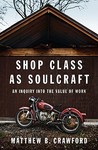
Book Review: Shop Class as Soulcraft by Matthew B. Crawford

Shop Class as Soulcraft: An Inquiry Into the Value of WorkShop Class as Soulcraft: An Inquiry Into the Value of Work by Matthew B. Crawford
My rating: 4 of 5 stars

This book clarifies some of the moral dilemmas intrinsic in a culture that values knowledge work and egalitarian autonomy over work done with physical things and face-to-face with people.  Work has consequences, and work that divorces itself from outcomes hides those consequences.  Knowledge work can be done in a way that keeps consequences to the forefront, and has been done that way in the past, but in our era it generally is not done that way.  This is a *moral* loss for the individual worker as well as the whole society.  I never thought of it that way.

Take this example: as recently as one hundred years ago, bankers were not allowed to operate banks in communities outside of their own.  People had to trust their banks.  Bankers were supposed to determine whether someone was a good credit risk when giving loans.  This knowledge was not just extrinsic, but tacit.  The banker would ask around, talk to local merchants, etc.  He was skilled at reading the responses of others in the community, and therefore able to use his intuitive judgment to reward virtue with a loan.  Nowadays, banks are national and international, loans are bundled and sold off to other entities (even other countries), and the banker is often required to offer loans to those who haven't demonstrated a pattern of trustworthiness.  This degrades the morality of the loan officer.

You can see this in government as well.  (This is my own rabbit trail, not included in the book.)  For instance, in TX right now we are debating whether people receiving food stamps ought to be required to take a drug test.  This is a dilemma for many reasons, but my main problem is how can you know? Obviously, you don't want to help someone who isn't interested in helping himself, but what if it is a family?  What about the rest of them?  And should government even be doing this?  Isn't helping the poor the duty of individuals and churches?  But what if individuals and churches are not involved enough in their communities to understand which individuals need and merit help and which do not?  See the problem?

Anyway, this is a very thoughtful book.  He does not extol the virtues of working with your hands to the exclusion of other work, but he does raise some questions about how we respect or disrespect our own humanity and that of others in the work we do and the work we value.  I have these questions too.  There are no easy answers, that's for sure.

I'm giving it four stars because I did find it difficult to navigate his analogies at times-- I'm not a mechanic. ;)  I was able to get around the difficulties though.  It is an excellent, thought-provoking book.  I recommend it to anyone that is a person, and educators/legislators especially.  Also to people in middle management who wonder why they feel so spiritually/mentally bankrupt.


View all my reviews

Saturday, November 17, 2012

Amadeus: a cautionary tale of pride and lust

Last night Mariel and I watched Amadeus.  (I recommend parental preview before watching with your kids to verify that it meets family viewing standards.)  Last time I watched it I think I was fourteen or fifteen years old.  I got so much more out of it this time.  I think Mariel, who is fifteen, got more out of it too than I did when I was her age.  (Further evidence of her superior education...)

I want to talk about the fictional Salieri.  (He was a real person, but the storyline in Amadeus is fictional.) He was court composer to the Emperor of Austria-- the Holy Roman Emperor, as he was known.

In the movie, young Salieri has a strange idea.  He thinks humans are in a position to bargain with God.  He vows that if God will make him a great composer, he will be completely chaste, humble and industrious, glorifying God in all his music.

Well, the Lord does not choose to do that, although Salieri thinks at first that he has.

He thinks God has answered his vow by causing his father to die.  He calls the death a miracle that changed him from "a frustrated boy in an obscure little town" to a citizen of Vienna, the city of musicians.

Salieri seems to have always been a bit off.

Anyway, he becomes court composer and honors his vow of chastity, industry and humility.  He is a good composer, but not a great one.  He also admires Mozart, whom he had never met.  Then they do meet, and Mozart turns out to be a vulgar, low, common person.  Salieri is appalled.

Apparently Salieri has made some rules about who is allowed to be amazing and who is not and God is not honoring his standards.

He tries to deny the genius of Mozart's music, but he cannot.  Time and time again he is astonished at its brilliance.  God is allowing this disgusting man to create beauty.

(At this point in the movie I wonder why Salieri does not realize his own presumption and pride, but it is always easier to discover another's sin than to comprehend your own.)

Actually, Mozart seems to me a person with both good and bad points.  Sadly, his daemons overcome his virtues in the end.  This is a tragedy.  And Salieri, who is in a position to help, instead succumbs to his own daemons and participates in Mozart's demise.  This is also a tragedy.  Mozart trusts him to the end, although Mozart's wife most emphatically does not.  She sees Salieri's true heart early in the movie.

Blinded by envy, Salieri is never willing to be a part of the beauty by helping Mozart.  Far from helping, Salieri actually encourages Mozart's madness by pretending to be the ghost of his father, whom Mozart believes is tormenting him into writing a Requiem.  Mozart eventually dies.  Salieri ends his life in the madhouse.  The one gave himself up to decadence and the other to pride.

I wonder what the Lord had to say to them in Heaven?  "Welcome.  Your sins are forgiven.  I love you and died for both of you.  I grant you peace.  Torment yourselves no more, but live with me in glory."

Oh, that they had allowed themselves the enjoyment of the earnest of that inheritance on earth!

(My apologies for the several updates.  Darn these tenses!)

Friday, June 17, 2011

"Through what we do and how we do it-- moment by moment, day by day, consciously or unconsciously-- we alter the chemical flows in our synapses and change our brains. And when we hand down our habits of thought to our children, through the examples we set, the schooling we provide, and the media we use, we hand down as well the modifications in the structure of our brains."

--The Shallows: What the Internet is Doing to Our Brains by Nicholas Carr (page 49)

How far do we embrace the new technologies? Where should the lines be drawn?

Sunday, May 29, 2011

For the Lurkers

Okay. I know you're out there. Just sayin'.

I have been watching my total pageviews the past week or two. I don't normally pay that much attention, but the amount has been increasing fast. So I finally took definite note of the number yesterday, and then looked at it today-- this blog has had over one hundred page views in twenty-four hours.

I am really glad people are visiting. The recent increase in traffic is most likely because of big search terms such as 'student whisperer' or 'when harry met sally', or other things I haven't thought of. I have a very simple site meter. It only shows me how many hits the page has gotten. So I don't know why ya'll are here, and you may not have stayed very long. But, welcome. Stay awhile and visit.

Please stay awhile and visit. I'd love to have a few two-way conversations on this blog. Even if all you have to say is, "I agree" or "You're totally off base" or "I have nothing to say on this topic". I'd love to know who is visiting.

You can comment anonymously too.

I'd especially like to hear from you if you think I am off base. How am I going to get to the truth if I am not challenged when I take a wrong turn?

Anyway, thanks for visiting. Please leave comments. :)

And now for a confession: I don't leave comments on blogs very often either. I found a couple of blog posts that might help with both of these problems.

6 Vital Reasons to Comment on Other Blogs

I do read and enjoy other blogs, but mostly do not leave comments. I need to start commenting more myself. I do have things to say about the blog articles of others, but it's sort of like walking up to group of people in a new social situation... you hope they will be your friends, but it really hurts if they ignore you, and do you want to take that risk? Such a high school worry, but there it is. I really hate it when I have put myself out there and I get ignored, especially if others are being engaged in conversation on the same post. At the same time, sometimes what my comment isn't relevant to the conversation thread that everyone else is taking (although it is relevant to the post), so I can understand why they might just leave my comment alone. But it still hurts my feelings. I need to develop a tougher skin.

10 Reasons Readers Don't Leave Comments

As a non-commenter myself, I confess my reasons for not commenting include #1, 2, 7, 9. And here are my other reasons, some of which were mentioned in the comments of the above posts:

1) As one of the commenters said, a lot of times I can't express exactly what I want to say and run the risk of being misunderstood or writing a huge blog post in the comments section trying to explain myself. Better to come back here and do that on my blog.

2) Sometimes I forget to go back and check to see if my comment received a reply, and I don't want that to happen, so I don't comment in the first place.

3) Some of the blogs I read are very popular, and, as another commenter said, I just don't think my comment will matter that much to the blogger.

4) I tend to say self-centered things, and then I think, "Am I trying to be the center of attention?" and delete the comment. But I'm WITH myself all the time. I know my own experience best. That is what I share. And then, I don't know when it's time to let the conversation thread end. I feel rude if I don't keep responding when I get a response, but, as the same commenter said, I feel clingy if I keep responding after a one or two responses to my comment. (I have the same problem on the phone, which is one reason I dislike talking on the things.)

As a blogger, I now wonder if my content is not rich or compelling enough to generate comments. Hmm. Another commenter to this article said that he doesn't get comments on his blog, but he gets stopped in public by friends who want to discuss what he wrote but won't comment. That happens to me too.

Thursday, February 03, 2011

Narration: What is Right With the World by G.K. Chesterton

(Chesterton's essay found here)

Chesterton says that his editor gave him the title of the essay, and that authors often suffer from the enthusiasm of publishers. He doesn’t mind this very much, but it is necessary to restate the title when the publisher writes it, since most of the time a publisher’s title is at once too complex and too simple. For instance, what is wrong with the world is the Devil, and what is right with the world is God; regardless of the muddles we get ourselves into, what is right and what is wrong will remain the same until the end of time. But at the same time, the fine details need to be puzzled out.

One of the most gratifying things of the current time is that so many of the prophecies of the learned have been proven wrong. This is mainly because the common man has not read the prophecies and does not realize he ought to proceed on a certain course. (Sort of like the cartoon character that flies along high in the sky until a bird tells him he shouldn’t be able to fly.) It is wrong to say he is uneducated though—schools will never teach the really important things, like “the dependence of infancy, the enjoyment of animals, the love of woman and the fear of death.”

What is right with the world is rooted in original realities, not in progress or change. Even revolution, which seems so revolutionary, is actually rooted in the ancient doctrine of the dignity of man. The progressive says that we have come from evil and are headed toward good. But Chesterton is more certain that we started with good. In the beginning God created the heavens and the earth, and He said they were good. Life is inherently good, although we may live in an evil or good way. “We are to regard existence as a raid or great adventure.”

What is currently wrong with the world (in addition to the Devil) is the idea that unity is always to be desired. This idea is essentially pessimistic. “Division and variety are what is right with the world.” The idea of one thing blending into another, ad infinitum, is a desire to return to the chaos before Creation. It is true that a man and woman, when married, become ‘one flesh’, but in one of those paradoxes so common in scripture, they are also distinct opposites of one another. How can we appreciate beauty without contrast?

The priggish pedants have decided that everything must blend, although the masses know the opposite to be true. It is hard to determine who will win, even though the masses have more numbers, because the deterioration of religious thought has left people at the mercy of their animal instincts. Animal instinct can be right, but animals can be cowed, too.

We make politics too important. We forget how much of life remains the same whether you are ruled by a Sultan or a Senate. The sunrise is glorious and getting out of bed is a nuisance, no matter what Government is in charge. As we attempt to change government for the better and cure social ills, we tend to disregard original principles about man and living—“in his long fight to get a slave a half-holiday [the typical modern man] may angrily deny those ancient and natural things, the zest of being, the divinity of man, the sacredness of simple things, the health and humour of the earth, which alone make a half-holiday even half a holiday or a slave even half a man.”

“The voice of the special rebels and prophets, recommending discontent, should, as I have said, sound now and then suddenly, like a trumpet. But the voices of the saints and sages, recommending contentment, should sound unceasingly, like the sea.”

(Quotes taken from Chesterton's essay. Also, this is my own narration, not one of the kid's.)

Tuesday, November 16, 2010

Speaking Worldviewishly

"He believes in passive mankind."

"They thought they were half the world, and the better half, too."

"Is he with Hyde or Frankenstein?"

"That's a shadow-word."

"My worldview sensor just went off."

"What does this say about cats, hats and the world?"

Sunday, June 06, 2010

Guest Blogger: George Washington's Limits

(Written by Aravis)

George Washington started his career as a surveyor, measuring off how much land belonged to a certain person. As a teenager, he was already learning the value of limits and boundaries, which would later become important in his political career. He was a soldier for several years, participating in the French and Indian War as well as the American Revolution, during which he rose to national attention. He helped to create the nation in the Constitutional Convention, where he was the head of the meetings.

Washington was what is now referred to as a “control freak”, but not in the usual meaning. He wanted complete control of himself, not others, and had set precise rules for himself since he was a child. This may have influenced him when he advocated a government with limited control over the individual – he believed people should be in charge of themselves, but knew that some civil government was necessary to deal with those who would not deal with themselves.

Technicalities for the role of President were still being hammered out when Washington assumed the position. If he had not been the right sort of “control freak”, the job of President could be drastically different today, because he was the one who shaped it. But he was aware of the human lust for power and also of the damage it could do, and kept himself from doing anything that was not for the good of his country. The limits he set for himself helped shape the entire nation.

Saturday, February 13, 2010

Ideas That Had Consequences

Andrew Kern is doing a series of posts on the rise of Hitler in Germany, which I find terribly interesting. I have always been fascinated by the human aspects of World War II (as opposed to the military paraphernalia and strategy aspects) and have wondered about Hitler for a long time. I have a few half-formed thoughts on it, but Mr. Kern gives more thoughts to ponder on the specific situation in Pre-WWII Germany, as well as on the influence of ideas, and human nature.

He has posted three articles so far, and plans to write more. I have excerpted a portion of each post, but please go read them in entirety:

Coming to a Republic, But Can You Keep It?

But Franklin knew, and his confederates knew, that a Republic is a precarious form of government, for human nature always tends toward some sort of collectivism.

Either people turn toward populism, which always leans on the monarch or the Fuhrer or the Messiah or the dictator to protect it from the ravages of the plutocrats.

Or they turn straight to the One to be protected from the uncertainty of life and the market.

But few people want to be free for the simple reason that freedom requires hard work, wisdom, and risk.


Germany, Austria and the Beginnings of Hitler

The great question of the 20th century has to be, “How did regimes as cruel as the Nazi’s in Germany, the Fascists in Italy, the Communists in Russia and China, find acceptance among the people’s they ruled?”

To be honest, though, the Nazi question is more important for two reasons. First, the Chinese and Russians came to power through a ruthless cruelty that involved a great deal less acceptance by the people they dominated. Second, we are much closer to the mindset of pre-Nazi Germany than we are to the mindset of pre-Bolshevik Russia or pre-Maoist China.

The disturbing thing about Nazi Germany is that Hitler was not only elected democractically (in a parliamentary system), but that he was elected under circumstances that allowed plenty of time for reflection.


Preparing the Way for Hitler

An evil on the scale of Nazism, or Communism for that matter, does not come about without a long gestation. It requires enormous technological power, ideas about reality and human nature, a certain national spirit, political systems and assumptions, and probably a good dose of demonic involvement.

The same is true of a good on the scale of our constitution and liberties.

Life is the interchange of ideas and applications. It is not possible to determine which comes first for the simple reason that neither exists apart from the other. An idea not embodied is an idea not thought.

Practically, therefore, our lives are a dialectic between our ideas and our circumstances. We dream big and try to make it happen. We find that we can’t perfect it, so we have to make a choice.

We can love the dream enough to accomplish as muc of it as possible. Or we can replace the dream with a fantasy and chase the hobgoblin of our dream. Or we can abandon the dream altogether.

Tuesday, May 12, 2009

Of People Who Write Essays for Fun (!)

...from a freewrite of Triss':

"People who write essays for fun like Sir Francis Bacon never act as though they're learning about a subject; their writing style sounds as if their essay was the definitive work. But I just plain don't know a lot about many subjects, so I can't write as though I did."

Saturday, October 25, 2008

For Javamom:

Okay, I read it!

(I liked it.)

And now I am recommending it to my eight twelve readers.

And I will try not to angst as much. Because I know the ending, too. ;o)

Sunday, September 14, 2008

Existentialism

(Does anyone else have a hard time remembering the definition of existentialism?)

princeton.edu: (philosophy) a 20th-century philosophical movement chiefly in Europe; assumes that people are entirely free and thus responsible for what they make of themselves.

Answers.com:
A philosophy that emphasizes the uniqueness and isolation of the individual experience in a hostile or indifferent universe, regards human existence as unexplainable, and stresses freedom of choice and responsibility for the consequences of one's acts.

Merriam-Webster: a chiefly 20th century philosophical movement embracing diverse doctrines but centering on analysis of individual existence in an unfathomable universe and the plight of the individual who must assume ultimate responsibility for acts of free will without any certain knowledge of what is right or wrong or good or bad

Wikipedia: a philosophical movement which posits that individuals create the meaning and essence of their lives, as opposed to it being created for them by deities or authorities or defined for them by philosophical or theological doctrines.

Wiktionary: A twentieth-century philosophical movement emphasizing the uniqueness of each human existence in freely making its self-defining choices, with foundations in the thought of Soren Kierkegaard (1813-55) and Friedrich Nietzsche (1844-1900) and notably represented in the works of Karl Jaspers (1883-1969), Gabriel Marcel (1887-1973), Martin Heidegger (1889-1976), and Jean-Paul Sartre (1905-80).

All About Philosophy:
There is a wide variety of philosophical ideologies that make up existentialism so there is not a universal existentialism definition. It is necessary to remain open and realize that most existentialists have a different view and form.

(Hee hee. Of course they do.)

Wednesday, September 10, 2008

Godly Women of the Bible.. Who Worked Outside the Home

A lot of people discussing Sarah Palin are pointing to Deborah and Esther as two examples of women working outside of the home, and even leading, in the Bible. It is very easy to shoot down these two examples because they are from the Old Testament, and also because both women rose to power at a time of extraordinary need in the history of Israel.

(Just briefly, although it is not the subject of this post, I want to rebut just a little of the criticism I have heard in comparing women today to Deborah. It is true that she was given command of an army because the men were too cowardly to stand up without her. However, the men were also cowardly in the time of David, Saul and Goliath. God did not *have* to raise up a woman to lead the Israelite army. He could have raised up a child, like he did with David. Or He could have commanded Barak to get over his cowardice, as He did with Moses. He didn't even have to make Deborah a judge, and yet He did.

I am not saying I think Sarah Palin is a modern-day Deborah. I do not know if she is. All I am saying is that God's ways are not are ways, and his thoughts are not our thoughts. Let's not pretend to understand what God is doing as events unfold. There will be time enough for that when all this is history and we can analyze with more leisure.

And now, back to the topic of this post.)

Two New Testament examples of ordinary women working outside of the home are Lydia and Phebe.

Phebe was travelling to Rome on business, and carried Paul's letter to the Romans for him.

Romans 16:1-2 I commend unto you Phebe our sister, which is a servant of the church which is at Cenchrea: That ye receive her in the Lord, as becometh saints, and that ye assist her in whatsoever business she hath need of you: for she hath been a succourer of many, and of myself also.


Lydia was a seller of purple cloth, and also one of the first Europeans converted to Christianity. She influenced her entire household to be baptized and her home became the first church in the city of Philippi.

Acts 16:14-15 And a certain woman named Lydia, a seller of purple, of the city of Thyatira, which worshipped God, heard [us]: whose heart the Lord opened, that she attended unto the things which were spoken of Paul. And when she was baptized, and her household, she besought [us], saying, If ye have judged me to be faithful to the Lord, come into my house, and abide [there]. And she constrained us.


These were ordinary women with ordinary lives who worked outside of the home and were not condemned for it by Christ or His Apostles. Indeed, Paul commands the church at Rome to help Phebe, which is an excellent way to show Christian love and demonstrate what Christianity is all about. Far better than criticism.

Previous post on this subject.

Monday, September 08, 2008

Thoughts for My Children on Government

Civil government exists to protect us, its citizens, from our enemies-- whether at home or abroad-- so that we can get down to the business of making something of ourselves.

It is also important to remember that, in its very nature, government is extremely vulnerable to corruption-- whether that government is red, blue, yellow, orange, or purple with pink polka dots. This is true at any level.

As Lord Acton (1834-1902) put it:

"Power tends to corrupt, and absolute power corrupts absolutely. Great men are almost always bad men."

Almost always, okay? Not always. But very, very often. A great, good man is quite rare. (And I use the term 'man' in the universal sense.)

William Pitt talked about unlimited power in 1770:

"Unlimited power is apt to corrupt the minds of those who possess it"

This is why the founding fathers of the United States designed a limited government. They understood that power is terribly vulnerable to corruption by sinful men.

Why do we have civil government, then? Because not enough of us have personal government; we do not govern our own selves well. This is the reason for crime and war.

It has been my experience (and is my understanding from studying history) that the bigger civil government gets, the less individuals are spurred toward personal government. This is why I do not agree with big government.

We do not have a king, nor do we want one, because of the corrupting influence of power. The "Divine Right of Kings" was a myth. There is only one King who has a Divine Right. This is why a representative democracy, or a democratic republic (we can parse those terms later), is the best government model put forth thus far. None of us are trustworthy when given too much power (not even a mob of "ordinary" people). Therefore, we have a government that by its very nature discourages government action and encourages an individual's dependence on himself.

Saturday, September 06, 2008

A Woman At Work

When I was six weeks old, my mother went back to her job as a planner with a prominent trucking manufacturer. She has worked outside of the home for my entire life, except for one year when I was twelve. I was taken care of by my grandmother, and later on my brother and I were cared for by my father's first cousin, whom my brother and I lovingly refer to as our 'other mom'.

We didn't know it at the time, but the Lord was preparing my mom to be almost the sole financial provider for her family later on.

When I was in college and still dependent on my parents' financial support (my brother had just finished high school), my father was declared legally blind and had to give up his driver's license. His work as a sales manager was partially contingent on his ability to drive, and his company fired him. It was a very difficult time for both my parents. It was a blessing that my mother had such a good job with excellent benefits-- it kept us afloat. And within two years, Dad and Mom had relocated to another state to follow Mom's job.

When my brother and I were kids, none of us knew how important Mom's career was going to be later on down the road. But the Lord knew. He was preparing something none of us understood yet.

And yet, my brother and I both understood that Mom was the keeper of the home. She kept us clean, well-dressed, well-fed, in a tidy home. She kept up traditions; documented events with pictures; took us on outings; attended athletic events, plays, recitals; sewed clothes, costumes, curtains and pillows; prepared for vacations and church meetings; and was very hospitable. (So hospitable, that often I was kicked out of my bed for overnight guests! I didn't mind, though. I liked company.) She was an excellent housekeeper, wife and mother-- and still is. With a full-time job outside the home.

Dad's eye situation actually freed him to do more studying and writing as a minister of the gospel. He was without a church to serve for many years, and wrote two books during that time, providing blessings for God's people as he used his analytical and research skills to write a church history, and a commentary on the subject of repentance.

My parents are going to be fine financially after retirement because of the blessing of Mom's career. She and Dad did not know that when she continued working after I was born. They just knew it was what she needed to do.

I firmly believe it was part of God's provision for our family that Mom be a worker outside of the home, as well as in it.

I have been spurred to write this because of the astonishing articles and comments I have been reading by conservative Christian women about Sarah Palin. Sisters, we do not know what God's plan is for every person on the planet. God moves in mysterious ways, his wonders to perform.

I am not saying who to vote for. Perhaps a write-in would be appropriate. I am not super thrilled with Senator McCain myself. I am shocked and dismayed at Senator Obama. Senator Biden disgusts me. Governor Palin seems a strong, stalwart warrior of a woman-- and I don't know how she does what she does. I do know her husband stands fully behind her, and in fact took a leave of absence from his career when she became governor of Alaska. He stays home to take care of the children, so they are not being neglected. I think I would feel an strong obligation to stay home with the baby and the wayward teenager myself.

But, Sisters, let us remember that just because we know scripture does not mean we know God's will for all. We know what we would do. We do not know what the Lord has given her to do. That is between her and God. Our job at this point is to look at the chess game of the election process and decide which move will cause the greatest number of godly choices down the road. Maybe it is making a symbolic stand with a write-in. Maybe it is voting for the least harmful and most likely to be elected choice.

It is a tough election cycle, that is for sure. But let's not destroy the house with our own hands. We are where we are in this country. Let's look at where we are right now, and decide how to vote in order to get *closer* to where we ought to be in the next four years, rather than further away.

I realize I am probably opening a can of worms here. That is why I generally do not post political commentary on my blog. But I had to stand and be counted as someone who thinks it is sometimes appropriate and God-honoring for a woman to have a career outside of the home. I believe God sometimes provides blessings in that way. I have seen multiple evidences of that as I have journeyed through life thus far, of which my mother is simply one example.

Another post in which are listed some godly women of the Bible who worked outside the home.

Wednesday, June 04, 2008

Relax...

Me: I've decided I need to learn to read Latin this summer.

Triss: You need to learn to relax?

Me: I need to learn to read Latin. There's a difference!