THE WAYFARER,
Perceiving the pathway to truth,
Was struck with astonishment.
It was thickly grown with weeds.
“Ha,” he said,
“I see that none has passed here
In a long time.”
Later he saw that each weed
Was a singular knife.
“Well,” he mumbled at last,
“Doubtless there are other roads.”
Thursday, May 02, 2013

Saturday, April 06, 2013
Book Review: Beauty Will Save the World
 Beauty Will Save the World: Recovering the Human in an Ideological Age by Gregory Wolfe
My rating: 4 of 5 stars
I liked this book. I especially liked the chapters on authors and political figures. I think my favorites were Wendell Berry and Russell Kirk, because I was fascinated with them to begin with, but didn't know much. I also liked the section on Flannery O'Connor, because it helped me understand why I can't get comfortable in her stories.
Parts of the book were rough going. Sometimes I had trouble following his arguments. Other times I struggled with my own lack of theoretical literary knowledge. I didn't get some of his terms, but chose to let them fly by rather than looking them up. I did not want to get bogged down with the dictionary.
I liked the autobiographical bits. They made the book more personal and were just plain interesting. I like knowing how a person's experiences have colored his ideas.
View all my reviews
Thursday, March 14, 2013
Review of the Harry Potter Books
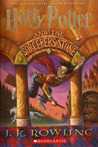 Harry Potter and the Sorcerer's Stone by J.K. Rowling
I read the series over Christmas break because Mariel had read it and I wanted to have conversations with her.
The first book is not very good writing. The writing and storyline get better as you read through the series, although it always seems somewhat self-conscious.
First... it's about witchcraft. I have definite philosophical/religious problems with that. Setting that aside, and looking at it as a parallel universe, it turns out to be a great story. I admire Harry Potter. He feels real, he faces difficult decisions, and he gradually comes to nobility.
Rowling is good at character development. I would be reading along thinking, "Ho hum, your basic tween/teen series with all the repetitive 'novelty' of that genre," then a character would take a turn that I didn't expect. This happened over and over. She makes you realize that it is easy to misread a person's actions-- that a bad guy may not be bad at all, you are simply taking his actions at face value.
I am noticing these characters more and more in current literature. I guess you call them anti-villains or anti-heroes, or what-is-this-person-a-good-or-bad-guy. Take Elphaba in the musical, "Wicked". (Also a witch, btw.) She seems to be the dysfunctional bad guy in Oz. Glinda appears to be the good one. Then Glinda seems to be the legalistic status-quo bad guy and Elphaba is the misunderstood, mistreated misanthrope who becomes noble. Then at the end they are both noble. Elphaba saves her world, and nobody ever knows.
Getting back to the Harry Potter series: Rowling is very good at this. What does this do for us as human beings in search of truth? I think it shows us that you NEVER know. You really never know. You have to judge people by their actions because that is what you see, but just remember... you never really know. God knows. We don't. I think it is a good reminder.
So I ended up liking the series. The characters were real and noble. I probably would wait to let students read the series until at least middle school.
View all my reviews
Subscribe to:
Posts (Atom)